Vibe Marketing for Meta Ads: What Actually Works When an Agent Runs Your Campaigns (2026)
What vibe marketing actually means for Meta ads: the chat-to-draft-campaign agent workflow step by step, the creative volume math behind it, the criticisms worth taking seriously, and the calls that should stay human.
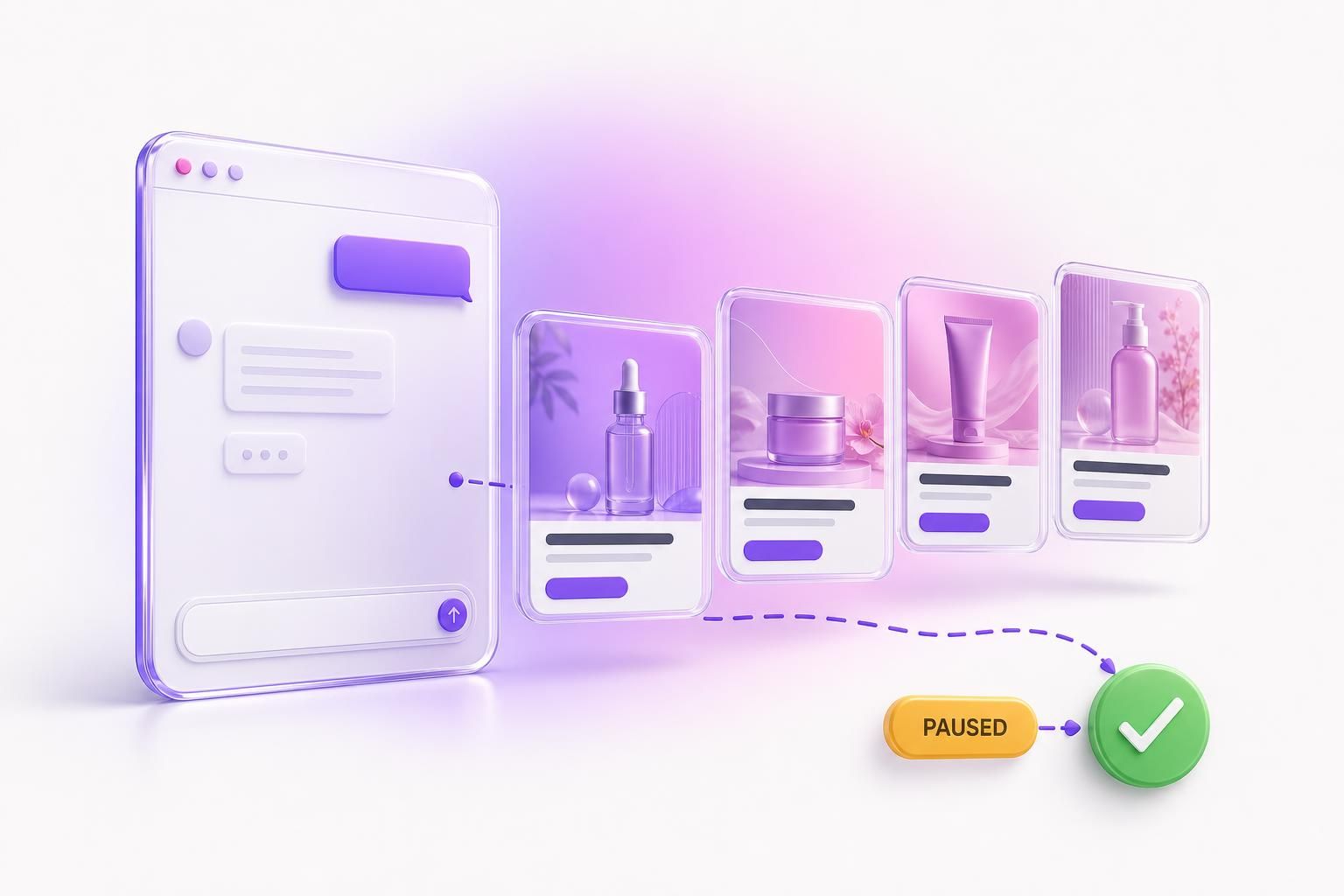
Vibe marketing is running marketing by describing outcomes in plain language and letting AI agents execute: the research, the creative, the copy, the campaign assembly. Your job moves from operating tools to directing taste and approving what ships. Applied to Meta ads, it compresses the distance between "here is the brief" and "here is a draft campaign" from days to one chat session.
Quick answer: natural-language briefs in, agent-executed marketing out, with a human approving the result. On Meta ads that means an agent researches competitor ads, generates creative variations against your brand kit, assembles a draft campaign through the official API, and waits for you to press publish. Budgets, account-level changes, and the final click stay human.
The hero example on our own agent landing page is one sentence: "Make 10 matcha ads and push them to Meta." That sentence is a complete work order now. This post is about what happens between typing it and money moving, and which parts of that gap you should refuse to close.
Where the Term Came From, and the Split Worth Knowing About
Andrej Karpathy coined "vibe coding" on February 2, 2025, describing a way of building software where you "fully give in to the vibes, embrace exponentials, and forget that the code even exists" (he later called the tweet a "shower of thoughts," which did not stop it from reorganizing an industry). Seven weeks later, on March 22, Greg Isenberg applied the pattern to marketing: the same acceleration that turned eight-week dev cycles into two-day sprints was hitting marketing teams, and he called it vibe marketing. Forbes picked the term up two days after that. The origin story practitioners tell adds one step: James Dickerson had been sharing agent workflows in a private Slack for weeks, and Isenberg gave the pattern its name.
One honest caveat before the definition settles. A minority of marketers use "vibe marketing" (or "vibes-based marketing") to mean something close to the opposite: brand work led by taste, mood, and cultural resonance instead of dashboards, and explicitly not AI automation. Andy Budd's November 2025 essay is the cleanest statement of that reading; he rejects the automation meaning outright. Both usages are real. This post uses the one nearly all practitioner content means in 2026: agents execute, humans direct.
Why Meta Ads Is the Arena Where Vibe Marketing Earns Its Keep
Motion's Creative Benchmarks 2026 analyzed 578,750 creatives across 6,015 accounts and $1.29 billion in Facebook and Instagram spend, September 2025 through January 2026. About 5% of creatives became winners, defined as spend of at least 10x the account median and at least $500. Roughly half of all creatives got little or no spend and were turned off before their 28th day. The winner rate ranged from 3.8% at accounts spending under $10K a month to 8.2% at accounts spending $1M or more.
Sit with the 5% number, because it is the entire case. If one creative in twenty wins, finding a winner is a sampling problem before it is a genius problem. The same report puts the biggest accounts at roughly 18 to 19 new creatives a week. At four tests a week you can expect around 0.2 winners weekly; at the top cadence, close to one. Volume does not guarantee winners. It is the only way winners show up often enough to matter.
In Motion's Creative Benchmarks 2026 (578,750 creatives, $1.29B in Meta spend), about 5% of creatives became winners and roughly half got little or no spend at all.
the loop, weekly
The stakes on the creative side are just as lopsided. A Nielsen study cited by Meta found creative quality drives 56% of a campaign's sales ROI, more than any other lever measured. Targeting and bidding keep automating away inside Advantage+; the creative input is the part still up to you, and it is exactly the part the 5% math says you are under-producing.
Meta agrees, in the most literal way possible. According to Wall Street Journal reporting from June 2, 2025, Meta plans to let advertisers fully automate ad creation and targeting with AI by the end of 2026. Zuckerberg described the endpoint at the 2025 shareholder meeting: "any business will be able to just tell us what objective they're trying to achieve... and connect their bank account and then we just do the rest for them." He called it "a redefinition of the category of advertising." The natural-language brief is where the platform itself says it is going. The open question is which parts you hand over, and the bank account clause is the one worth reading twice.
We ran the volume economics in more depth in the creative volume wall post: Loop Earplugs runs 500+ concurrent Meta ads, and top DTC brands ship 50 to 70 new ads a week. The wall is real, and creative production at that cadence is precisely the kind of work agents are good at: repetitive, reversible, and cheap to redo when a draft misses.
The Workflow: Chat Brief to Draft Campaign, Step by Step
Here is the concrete version, mapped to tools that exist rather than a keynote demo. Every step below runs inside Agent Flow, our agent for Meta ads, or from your own Claude or Cursor over MCP (setup in the Claude-to-Meta-ads guide). Nothing in it requires a capability that is not shipping today.
Step 1: Write the brief like a colleague, not a form
The input is one message: the product, the audience, what you want out of the run. "Research what competitors in our niche are running on Meta and draft me 12 variants for our product" is a complete brief. Specificity still pays; "for cold traffic, lead with the price objection" gets you a sharper batch than a bare ask. The thing being replaced is the intake form, not the thinking.
Step 2: Let the agent run the research pass
The agent sends research subagents across the web, customer reviews, and competitor ads in the Facebook Ad Library, then hands back the language buyers actually use plus the angles competitors are paying to keep live. Winners go to a swipe file. This step matters more than it looks: it grounds generation in ads that are verifiably running, not in what an image model imagines ads look like. A Tuesday of tab-hopping compresses into a few minutes, and the output improves at the same time.
Step 3: Generate variations in batches, against your brand kit
This is where the 5% math gets answered. The agent pulls from your brand kit and your past winners and generates up to 10 variations per run, at about 30 seconds an ad, across feed, story, and square. At that speed, 15 to 20 fresh creatives a week is a realistic solo cadence instead of an enterprise team's output. The DIY side clocks in slower but the same shape: Keanan Koppenhaver's Claude Code for Marketers benchmark is 3 to 4 ad variants in about 30 minutes, iterating in plain English ("too corporate," "more playful").
Step 4: Attach copy that matches
Headlines, primary text, and CTAs get generated to match each variant rather than pasted from a doc. Angle and copy travel together, so the cost-math visual ships with cost-math copy instead of whatever was in the clipboard.
Step 5: Assemble the draft campaign
The agent builds the structure: campaign, ad sets, ads, server to server through the official Marketing API from your OAuth-connected account. It runs a preflight, then hands you a review card. Everything lands paused. Meta's own Ads MCP server, launched April 29, 2026, works the same way: its campaign tools create objects paused by default. When the platform's own agent interface refuses to auto-publish, treat that as the spec, not a limitation.
Step 6: Approve, ship, read, regenerate
You review, approve, publish. Then the loop starts paying: read the results, pause the losers (pause, never delete; deleting throws away learning history), and brief the next batch against what the winners taught you. The agent drafts replacements before fatigue lands, so you review candidates instead of restarting from a blank canvas.
What a Run Actually Looks Like
The condensed version of the loop above, in the interface where it happens. Notice the shape: the agent narrates what it is doing, shows its work at each stage, and ends in a paused state that waits for a human.
Researching competitor ads in the Ad Library... 14 found
Three angles repeat across the top spenders: testimonial, cost math, and before and after. Most hooks anchor on price.
Generating variants against your brand kit...
12 variants drafted. Here are four; feed, story, and square sizes are in the set.
 Testimonial
 Cost math
 Before / after
 Founder story
1 campaign, 2 ad sets, 12 ads assembled through the official Meta API. Nothing publishes or spends until you approve.
Compressed for length, but nothing here is invented: the research pass, batch generation, and paused draft are the product's real surfaces, and the four thumbnails are real generated ads from our own account.
The vibe marketing workflow for Meta ads, already assembled
Agent Flow runs the loop in this post from one chat window: competitor research from the Ad Library, up to 10 on-brand variations per run, and draft campaigns through the official Meta API that publish only after you approve. Free credits, no card.
What Stays Human
The Zuckerberg pitch ends with "connect their bank account and then we just do the rest." That is the exact line we built the product not to cross, and not out of sentimentality. Three things stay human on purpose:
- Budgets and spend caps. The agent can assemble a campaign; it does not get an opinion on how much you can afford to lose this week. No autonomous budget optimization, no autonomous bid management.
- The final approval. Agent proposes, human presses go. Every ad, every push. Nothing publishes or spends until you say so.
- Account-level changes. Payment methods, page roles, pixel settings. Automated actions on account surfaces are disproportionately what trips Meta's enforcement, so the agent simply does not have those levers.
The enforcement point deserves the emphasis, because it is the one that costs people their accounts. What decides ban risk is the method your agent uses to touch the account, not the fact that an AI is involved. Browser automation that logs into Ads Manager and clicks around looks like account takeover to Meta's systems. API access through a scoped token, with a human approval gate before anything spends, is the supported path. The full breakdown, including what actually triggers the automated flags, is in our guide to automating Facebook ads without getting banned. Meta's paused-by-default MCP design points the same direction: the platform assumes a human confirms activation.
The Criticisms, Taken Seriously
Slop at scale. Tom McFadden of the Jacob Tyler agency, June 2026: "Feed it three adjectives and good intentions and it hands you the same beige every other company's AI hands them... You get the statistical average of the internet, wearing your logo." He is right about the failure mode. Prompt an image model cold and the average is what you get. The fixes are boring and structural: a brand kit the agent must pull from, past winners as references, competitor research as grounding, and a human who rejects drafts. His second line is the harder one: "If your team can't agree on how the brand sounds, neither can ChatGPT." No workflow rescues a brand that has not decided what it is.
Hype and vendor cash. Oren Greenberg's read, in Backlinko's vibe marketing piece: "The level of hype is out of this world... it's mostly the vendors who are minting cash." Fair, and the ads niche is among the worst offenders; most of what ranks for this keyword plus "Meta ads" is vendor content leaning on ROAS multiples nobody can audit. The Backlinko author also documents four-plus hours failing to get a simple DIY workflow running, which matches the reality of the generic stack better than any 20x claim does. That gap between demo and Tuesday is why this post shows a workflow and cites Motion's dataset instead of quoting a ROAS.
Taste still decides. True, and the 5% winner rate is exactly why the workflow exists anyway. Volume without judgment is slop at scale: twenty ads shipped, twenty shades of beige. Judgment without volume starves the algorithm: four tasteful ads a month into a one-in-twenty lottery is a slow, expensive way to learn. The agent covers the volume half. The human covers the judgment half. Kevin White of Scrunch AI puts the division well: "AI multiplies the abilities of people who already know their craft." Koppenhaver again: "Vibe marketing doesn't replace marketing instincts... It accelerates them." That is the position this post takes too.
The Tool Landscape, Honestly
The canonical vibe marketing stack in the discourse is n8n for orchestration, Claude or ChatGPT for reasoning, and image or video models for creative. It is capable and it is fiddly. Budget real hours for plumbing, and reread the Backlinko experience before committing a sprint to it. DIY earns its cost when your workflow is unusual, spans channels beyond paid social, or you want to own every node.
For Meta ads specifically there is a vendor cluster: Icon, AdCreative.ai, Creatify, and others, each covering a slice such as ad cloning, creative scoring, or batch video. AdMakeAI's position in that field is the ads-specialized version of the general pattern: chat-driven like the generic stack, with the Meta plumbing already built. Ad Library research, brand kits, batch generation, campaign drafts through the official API, and the approval gate in one place. It is also open over MCP, so it slots into a DIY stack as the ads node; our connect hub tracks which ad platforms have official MCP servers to pair it with.
Vibe Marketing FAQ
Brief in. Draft campaign out. You keep the final click.
Research competitor ads, generate on-brand variations, and draft Meta campaigns from one chat, with every push waiting on your approval. Free credits, no card.
Related Resources
How to Connect Claude to Meta Ads
The MCP setup behind the workflow in this post, including Meta's official Ads MCP server.
Automate Facebook Ads Without Getting Banned
Why the connection method, not the AI, decides whether your account survives.
The Creative Volume Wall in Meta Ads
The production-cadence math this post builds on, with the brands already running it.
How to Create Facebook Ads With AI
The hands-on generation guide, from product photo to finished creative.
Make your next ad from what already runs
Research what competitors are running, then generate your own on-brand ads in minutes.