The Creative Volume Wall: Why Loop Runs 500 Meta Ads At Once (And Your 10/Month Is Killing You)
Loop Earplugs runs 500+ concurrent Meta ads. Top DTC brands ship 50-70 new ads per week. Here's the volume math most advertisers ignore, the frameworks 8-figure brands use, and how to hit real creative volume without a €1.5M/month budget.
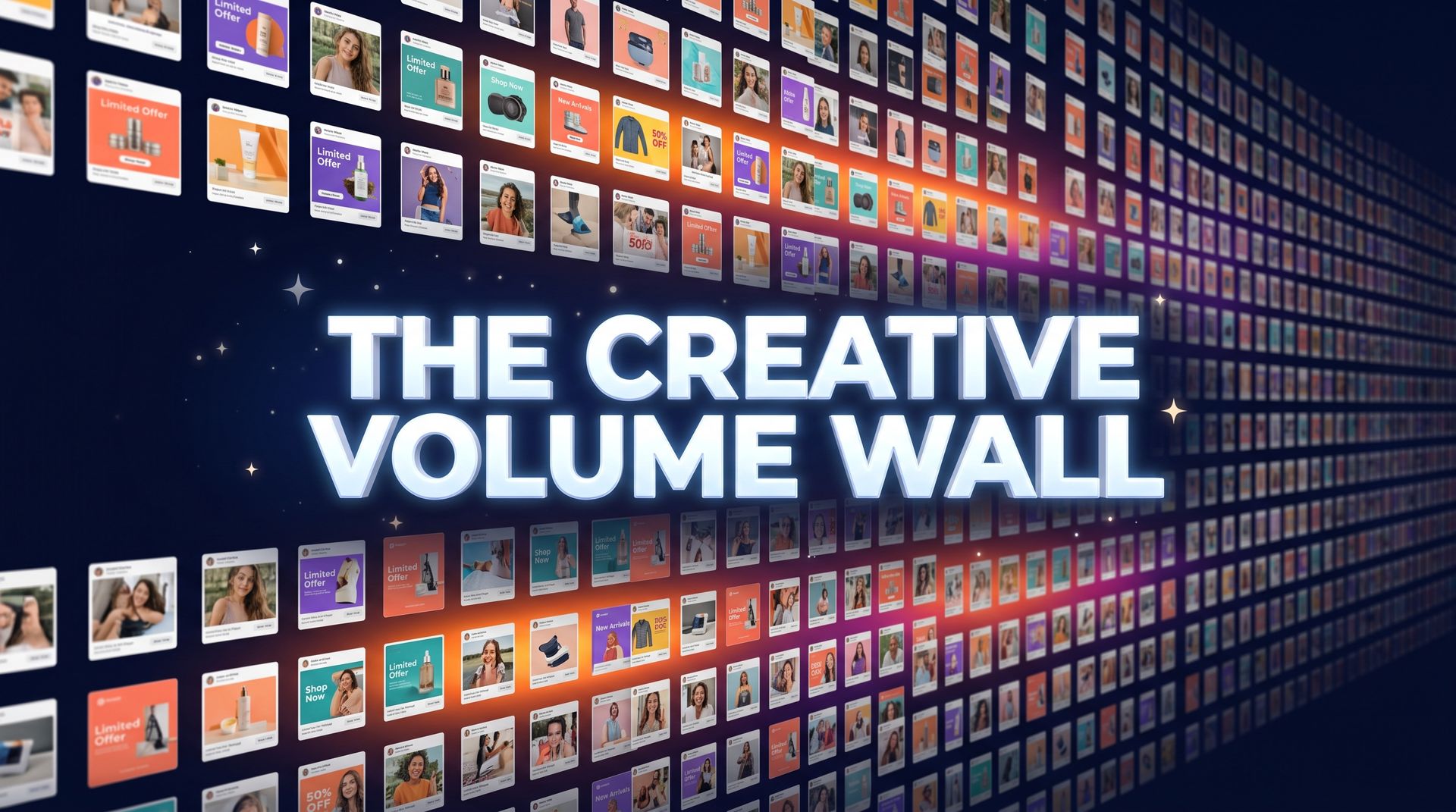
You just launched your 12th ad of the month and you're exhausted. Brief written. Creator hired. Footage shot. Edited in Premiere. Copy rewritten three times. Uploaded, tagged, scheduled. You crack open a beer. Meanwhile, Loop Earplugs launched 12 ads this morning. Before lunch. And they'll ship 40 more by Friday.
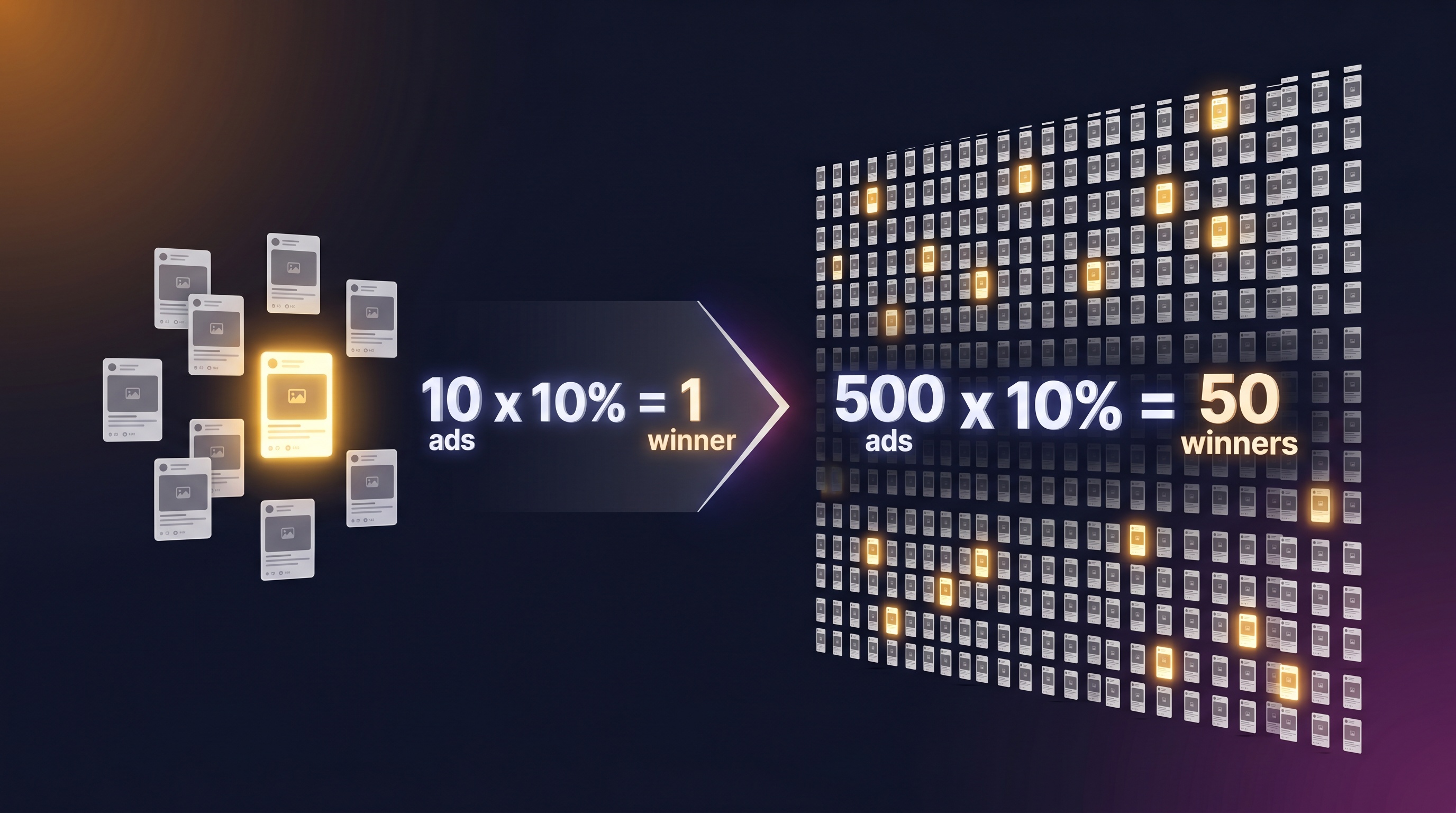
The Bottom Line: You're not stuck because your creative is bad. You're stuck because you're running 10 ads a month in a market where Loop Earplugs runs 500+ concurrent ads on a €1.5M/month budget. If the best ads win ~10% of the time and you're only testing 10, you get 1 winner - maybe. That's not a creative problem. That's a volume problem. And Meta's Andromeda algorithm has made it worse.
The Loop Earplugs Case Study: A Belgian Earplug Brand Printing Money
Loop was founded in 2016 in Antwerp by Dimitri O and Maarten Bodewes. Their product is a silicone earplug. It costs a few euros to make. It retails for €25-€40. In 2022 they did around $63M in revenue. By 2024 they were reportedly past $250M. In early 2026, public estimates peg them close to half a billion annually.
Here's what the ad spend looks like once you dig into the Meta Ad Library and the public agency breakdowns from Praella and Common Thread Collective:
| Metric | Loop Earplugs |
|---|---|
| Concurrent active Meta ads | 500+ at any given time |
| Monthly Meta ad spend | ~€1.5M |
| Lifetime ads produced | ~40,000 |
| New ads per week (estimated) | 50-100+ |
| Distinct customer tribes targeted | 15+ (sleepers, ravers, ADHD, parents, seniors, etc.) |
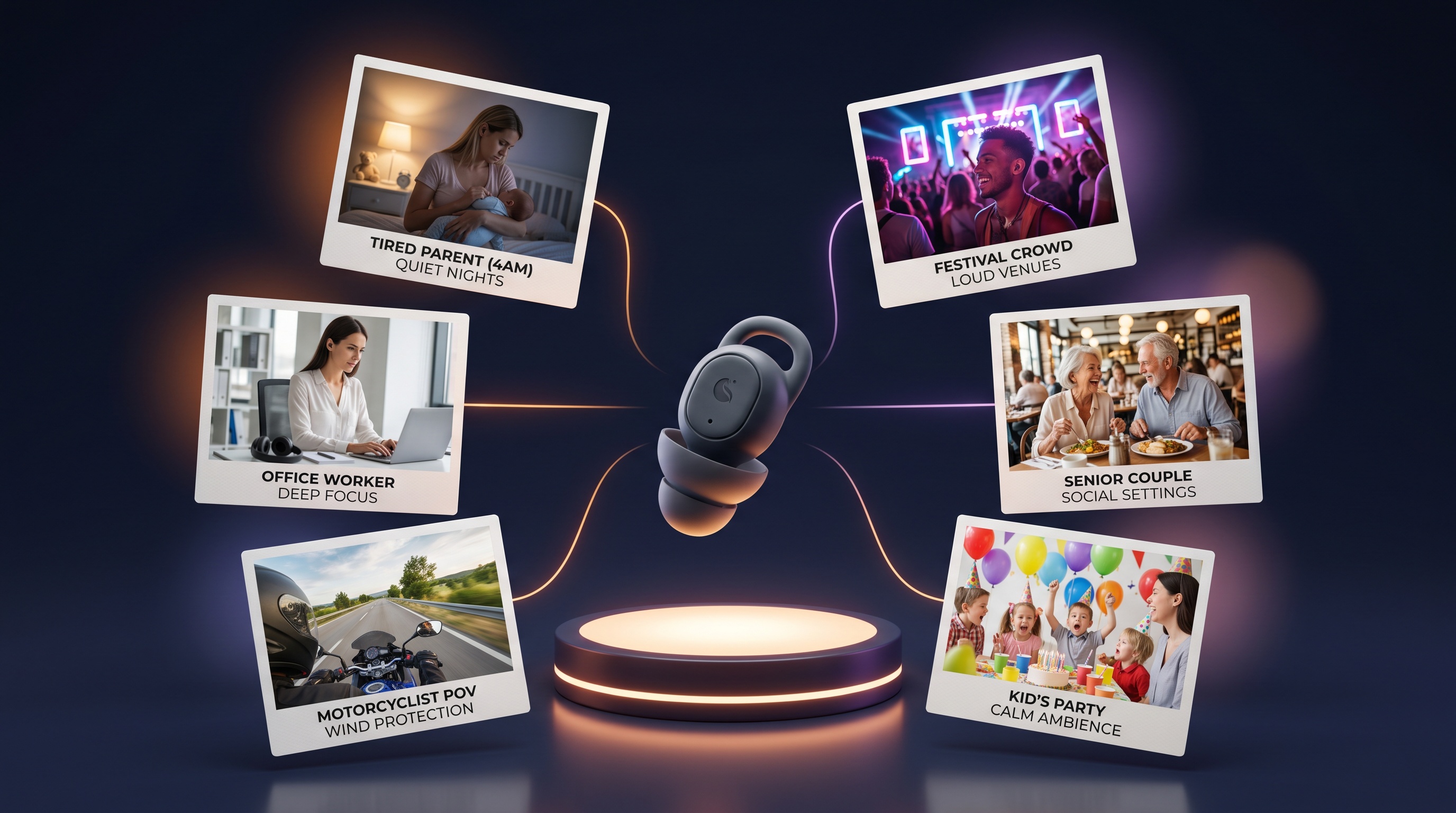
The strategy isn't "run a lot of ads." The strategy is tribal segmentation at a creative level. Loop doesn't try to speak to "everyone who wants earplugs." They make entirely different ads for:
Sleep-seekers
Exhausted new parents, shift workers, people with snoring partners. Hook: "I finally slept through the night in 6 months." Creative style: tired-selfie UGC at 4am.
Festival-goers
Tomorrowland crowd, DJs, club kids. Hook: "Your future self at 40 will thank you." Creative style: neon concert footage, bass-drop b-roll.
ADHD/neurodivergent professionals
Remote workers, over-stimulated knowledge workers. Hook: "The open office isn't your fault." Creative style: calm text-on-screen, soft pastel palette.
Parents of toddlers
Birthday parties, fireworks, loud sensory environments with small kids. Hook: "The meltdown you prevent is worth €30." Creative style: chaotic UGC from a kid's birthday party.
Seniors at brunch
People over 55 who can't hear in loud restaurants. Hook: "You're not old. The restaurant is loud." Creative style: glossy warm-toned shots of Sunday brunch.
Motorcyclists and commuters
Wind noise prevention. Hook: "What 30 minutes on the highway does to your hearing." Creative style: POV riding footage.
The compounding effect:
Each tribe needs its own creative, its own hooks, its own angle, its own visual language. Multiply 15+ tribes by 5+ creative variants each by 3+ formats (static, UGC video, carousel) and you're already at 225 ads - before you test a single new hook. That's how you get to 500 concurrent.
The Volume Math Nobody Does (But Should)
Let's stop hand-waving and do the actual math. Ask any experienced media buyer what percentage of ads become "winners" - ads that hit target CPA and scale profitably - and you'll hear the same answer across Foxwell Digital, Pilothouse, Motion, and every Reddit thread on r/FacebookAds.
The industry consensus:
Roughly 1 in 10 ads becomes a real winner. Most agencies cite win rates between 5% and 15%. Foxwell's published data says ~10%. Barry Hott has said publicly that for most DTC brands, the hit rate is "somewhere between one in eight and one in twelve." The rest either die quietly or become background noise.
Now run the arithmetic:
| Ads launched per month | Expected winners (at 10%) | What this looks like in practice |
|---|---|---|
| 5 | 0.5 | Half the time you get nothing. Blame "the algorithm." |
| 10 | 1 | One winner. You scale it. It fatigues in 2 weeks. You're back to zero. |
| 50 | 5 | Real pipeline. Always a fresh winner ready when one fatigues. |
| 200 | 20 | Ridge Wallet, Hexclad, Magic Spoon territory. Different winners for different segments. |
| 2,000 | 200 | Loop Earplugs. 200 winners isn't luck - it's the math. |
The Reddit pattern nobody wants to hear:
From r/FacebookAds, posted hundreds of times in various forms: "I test 2 ads, one 'wins' at $40 CPA, I scale, it tanks in 2 weeks." That's not bad luck. That's a sample size problem. Two ads isn't a test - it's a coin flip. You didn't find a winner. You found an outlier and assumed it was a winner because you only had two data points.
Think about it this way: if you flip a coin twice and get two heads, you don't conclude the coin is rigged. But if you launch two ads and one gets $40 CPA, advertisers routinely conclude they "found the formula." Nick Shackelford has made the point repeatedly: you need at least 10-20 ads to know which one is actually a winner vs. a statistical blip.
Andromeda Made This Worse (If You Haven't Adapted)
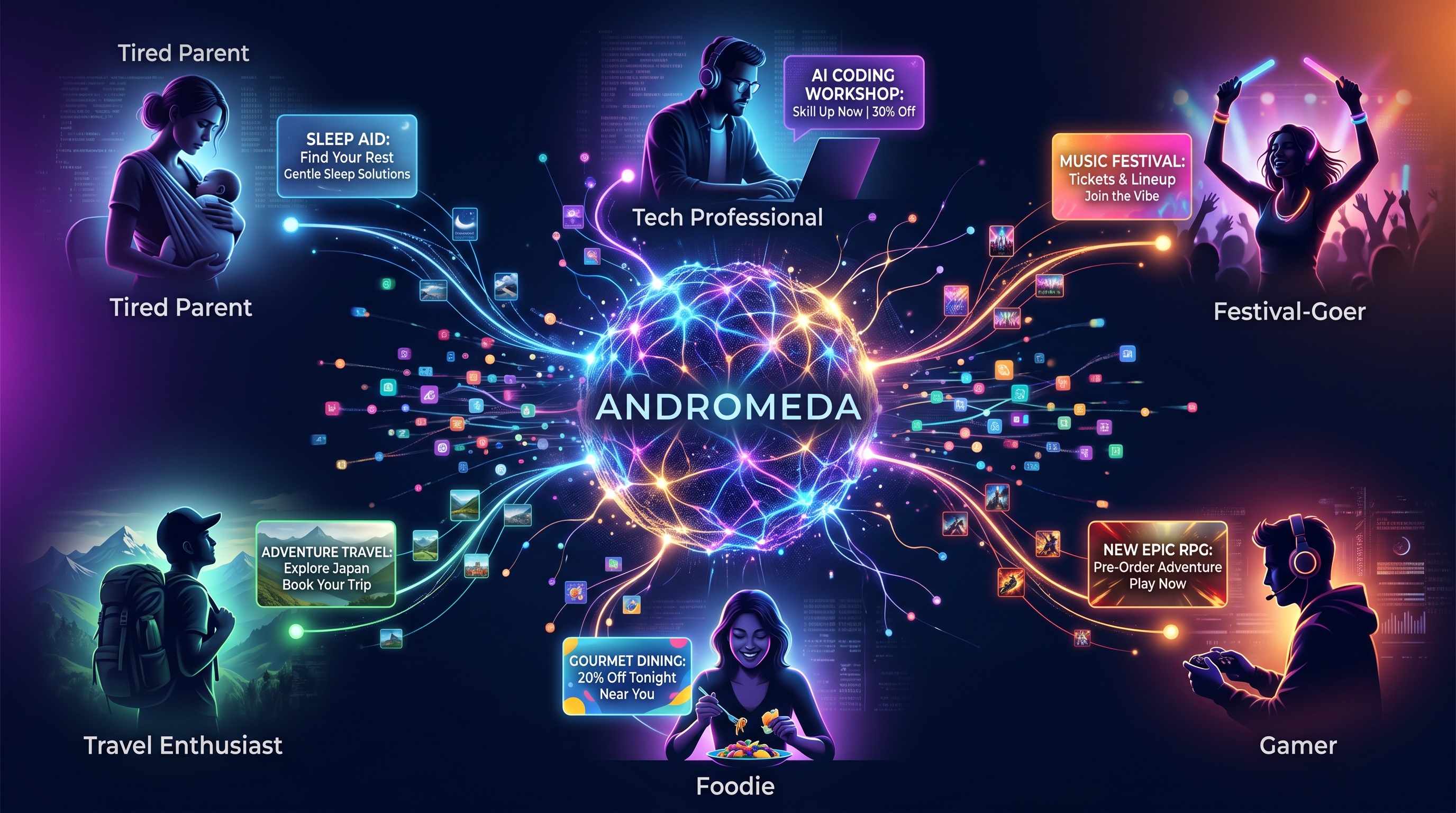
Meta's Andromeda algorithm went fully global in early 2026. It's a personalized ranking model that uses a 10,000x larger neural network for ad retrieval than the previous system. In plain English: it picks which specific ad to show each individual user, and it picks based on signals from that user's behavior - not from your targeting cluster.
Andrew "Boz" Bosworth, at Meta Q4 earnings:
"Audience marketing is effectively dead. The model can find who will convert - your job is to give it enough creative signal to pick from."
Translation: Meta doesn't need you to tell it who the "ADHD professional sleep-seeker aged 28-40" is. It already knows. What it needs from you is enough creative variety that it can match an ad to a user. If you give it 3 ads, it has 3 options. If you give it 300, it has 300.
This is a fundamental shift. Pre-Andromeda, you won by finding the right audience. Post-Andromeda, you win by feeding the algorithm diverse creative and letting it sort users for you. Foxwell Digital's Andrew Foxwell put it like this on his podcast in February 2026: "The new media buying job is creative ops. The buyer who ships 80 ads a week is going to destroy the buyer who ships 8, regardless of which one is 'smarter.'"
Motion's 2026 benchmark report showed the gap clearly: top-performing ads now hit 40%+ hook rates (viewers watching past the first 3 seconds). Bottom-quartile ads sit below 15%. The ads that get picked by Andromeda and scaled are the top 10% - which is why running 10 ads and praying gives you nothing, and why running 100 ads gives you a functioning business.
What Actual Volume Looks Like at Each Stage
Based on data from Foxwell Digital, Pilothouse, Common Thread Collective, and multiple agency public reports, here's what creative volume actually looks like at each tier of DTC:
| Stage | Monthly Spend | New Ads/Month | Concurrent Active | Example Brands |
|---|---|---|---|---|
| Startup | $0-$10k | 5-10 | 3-8 | Most Shopify stores in year 1 |
| Early Growth | $10k-$50k | 20-40 | 15-30 | Bones Coffee ($10M era), Jones Road (early) |
| Scaling | $50k-$250k | 50/week+ | 80-150 | Liquid IV (early), Magic Spoon, Ridge Wallet |
| 8-Figure | $250k-$1M | 100+/week | 150-300 | Hexclad, Jones Road (current), Bones Coffee (current) |
| 9-Figure | $1M+ | 200+/week | 500-1,000+ | Loop Earplugs, Liquid IV (current), Olipop |
The uncomfortable truth: when a $50k/month brand looks at its flatlining revenue and blames "the ads aren't working," the intervention is almost always "you're running 8 ads, you need 30." Every. Single. Time. Ridge Wallet publicly confirmed in 2024 that they run a minimum of 50 concurrent ads across their media buys. Not because they're showing off - because anything less leaves the algorithm starving for options.
Barry Hott, on the creative gap:
"The biggest gap between a $10M brand and a $100M brand isn't product. It's creative volume. The $100M brand tests what the $10M brand tests in a month, in a single day."
The 3 Frameworks 8-Figure Brands Actually Use
Volume without structure is just noise. These are the three frameworks the best-run DTC creative teams actually operate inside. They're not secret - they've been published, podcasted, and talked through on dozens of agency calls. They're just not done, because most brands can't produce the creative fast enough.
1. Foxwell's 15-50 Per Ad Set Framework
Andrew Foxwell (Foxwell Digital, ex-Meta) has been hammering this point for years: each ad set should have 15 to 50 distinct ads running simultaneously. Distinct - not variations of the same ad. Different hooks, different formats, different angles, different creator, different problem framing.
The number depends on spend: a $100/day ad set can run 15. A $1,000/day ad set needs 40-50, because the algorithm burns through impressions at that spend and fatigues creative in days, not weeks.
2. Pilothouse's "3-3-3" Testing Framework
Pilothouse (the creative agency behind brands like Hexclad and Ridge Wallet) runs a 3-3-3 test cadence for every new concept:
- 3 concepts - e.g., problem/solution, founder story, customer testimonial
- 3 hooks per concept - different opening lines or visual stop-scrolls
- 3 formats per hook - static, 9:16 video, 1:1 UGC
That's 27 ads per testing batch. They run one batch per week minimum. At $50k/month spend, you're never starved for creative - and you always have 2-3 batches of data to pull winners from.
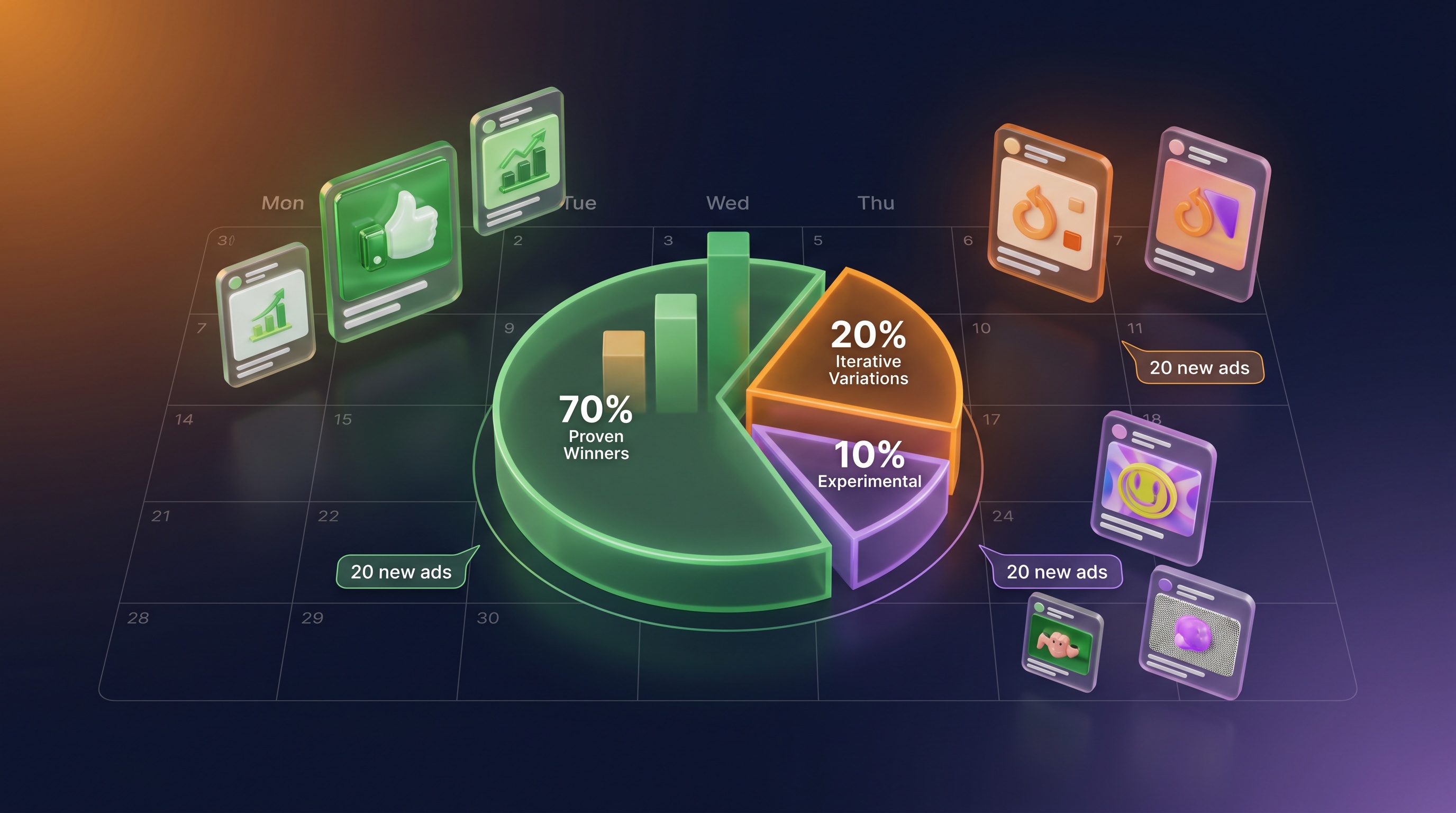
3. The 70/20/10 Budget Split
Referenced by both Common Thread Collective and Motion's playbook series, the 70/20/10 rule determines where your ad dollars go:
- 70% - proven winners. Ads with a track record of profitable CPA at your target scale.
- 20% - iterative variations. Same winning concept, new hook, new creator, new background. Extending lifespan.
- 10% - fully experimental. New angles, new formats, things you genuinely don't know if they'll work.
Starter mistake: running 100% proven winners until they fatigue. Then scrambling to produce new creative in a panic. The 10% experimental slot is how you always have the next winner already half-tested before you need it.
Nick Shackelford's $100 Rule:
"Test any angle with a static image ad first, under $100, before you invest a single dollar in production. If the angle doesn't work as a static, it won't work as a $5,000 UGC video. The static tells you the message is right. Then - and only then - scale the production."
This Is Literally What AdMakeAI Is For
The reason most brands can't hit real volume isn't strategy - it's production. You can't pay a designer to ship 50 ads a week. You can't brief an agency fast enough. AdMakeAI lets you generate 50+ distinct ad variations in minutes from a single product photo: different hooks, formats, backgrounds, angles, and tribes. This is the shovel for Loop Earplugs' gold mine.
How to Hit Real Volume Without a €1.5M Budget
You don't have Loop's budget. You don't have Jones Road's in-house creative team. You don't have Pilothouse on retainer at $40k/month. Fine. Here's a realistic playbook that's actually been used by founders doing $30k-$300k/month to break past the volume wall:
Step 1: Identify 3-5 customer tribes
Don't try to do 15 like Loop. But you absolutely need more than one. Look at your existing customer data - who actually buys? Segment by use case, not demographics. A parent buying earplugs for sleep is a different tribe than a parent buying for their kid's birthday party, even if both are "moms 30-45."
Output: 3-5 distinct messaging angles.
Step 2: Apply 3-3-3 per tribe
For each tribe, generate 3 concepts × 3 hooks × 3 formats = 27 ads per tribe. Times 5 tribes = 135 ads. That's your first batch.
Reality check: You're not going to film 135 UGC videos. Most of these start as static image ads under Shackelford's $100 rule. Only the angles that prove out become videos.
Step 3: Ship a 20-ad batch every Monday
Forget "we'll do a big creative refresh once a quarter." That's dead. Scaling brands run a weekly creative cadence: every Monday, 20 new ads go live. 15 are iterative variations of things that already worked. 5 are genuinely new.
Monthly output: 80 new ads. That puts you in serious Growth-stage volume territory.
Step 4: Use AI to kill the production bottleneck
This is the part that was impossible pre-2024 and is trivial now. You cannot ship 80 ads a month by briefing a designer. But with AI image generation, a founder can produce 50 ad variations in a single sitting. Different backgrounds, different formats, different scenes, different lighting, all from the same core product photo.
What used to take: $3,000 and 2 weeks of agency back-and-forth.
What it takes now: an afternoon.
Step 5: Track the 70/20/10 split ruthlessly
Every Monday, before you ship the 20 new ads, look at your current active set. Is 70% of your spend going to proven winners? Is 20% going to iterative variations? Is 10% being genuinely wasted on experiments? If any of those numbers are wrong, rebalance before you launch more.
The math for a $50k/month brand:
80 new ads/month × 10% win rate = 8 winners per month. At that rate, you're never without fresh creative. One winner fatigues? You have 7 others in the pipeline. Compare to 10 ads/month = 1 winner that burns out and leaves you scrambling.
Other Brands Hitting This Volume Right Now
Loop is the extreme. But they're not alone. Here are other named DTC brands publicly documented running high-volume creative strategies:
Jones Road Beauty
Bobbi Brown's second act. Publicly ran 150+ concurrent Meta ads at their scaling phase. Mixed founder-UGC Bobbi-speaks-to-camera content with polished beauty shots and customer testimonials.
Reportedly $20M in first year. Heavy Meta creative investment from day 1.
Ridge Wallet
Founders Sean Frank and Daniel Kane openly discuss their creative operation. They've said on podcasts they run 50-100 concurrent ads minimum, and test ~30 new creatives per week.
Known for the "creative machine" approach: dedicated in-house creative team producing weekly.
Bones Coffee
Flavored coffee brand. Currently running 200+ concurrent ads across flavors. Each flavor (Maple Bacon, Salty Siren, Strawberry Cheesecake, etc.) is essentially its own creative tribe.
A portfolio-of-tribes strategy, just like Loop - except with flavors instead of use cases.
Hexclad
Pan brand backed by Gordon Ramsay. Runs 100+ concurrent ads, with heavy Pilothouse involvement. Uses 3-3-3 testing religiously. Aggressive hook-testing: the same product gets 20 different opening lines.
Estimated $200M+ in revenue. Creative velocity is the edge.
Liquid I.V.
Hydration multiplier (now owned by Unilever). Runs 300+ concurrent ads. Segments by occasion: hangover, hot weather, sports recovery, hiking, flying, hospital visits.
Classic tribal targeting - one product, 10+ distinct problem framings.
Magic Spoon
High-protein cereal. Publicly documented weekly creative refresh cadence, typically 40-60 new ads per week during scale-up. Heavy rotation of founder-story, customer testimonial, and before/after-macros formats.
Reached $100M+ run-rate largely via Meta creative velocity.
Common Objections (And Why They're Wrong)
"More ads just means more creative fatigue"
The opposite is true. Creative fatigue hits faster when you have fewer ads because each one absorbs more impressions per user. Running 50 ads spreads the frequency. Each user sees a different ad, so the same user doesn't see the same creative 8 times in a week.
Foxwell's own data: brands running 40+ ads per ad set see average creative lifespan of 45+ days. Brands running 5 ads per ad set see lifespans of 10-14 days.
"I can't afford to produce that many ads"
You can. What you can't afford is the old way of producing that many ads - the $500/ad UGC creator model. But AI image generation means your per-ad production cost is cents, not hundreds of dollars. An afternoon with AdMakeAI's Ad Set Studio produces what used to take two weeks with an agency.
"My brand is too premium/niche for this"
Loop sells silicone earplugs. Jones Road sells a clay eyeshadow. Ridge sells a metal wallet. None of these are "mass market" - they all won by finding 10+ distinct tribes who cared about their product for different reasons. Niche is the reason you need more ads, not less. You have fewer people to convert, so you need more shots at each micro-segment.
"I don't know which ad is the winner with that much data"
Meta's reports handle this. Sort by Cost Per Purchase or ROAS, set a minimum spend threshold ($50-$100 per ad), and filter. Motion and Northbeam are the standard tools for creative-level attribution at volume. Ironically, running more ads makes winner identification easier, not harder - you have more statistical power.
Stop Running 10 Ads A Month. Start Running 80.
The brands crushing Meta in 2026 aren't better strategists. They ship 10x the creative. AdMakeAI is built for exactly this: generate distinct, high-quality ad variations in minutes, not weeks. Your volume wall disappears.
Free credits included • Generate 50+ ad variations in one session
Related Resources
Why Your Winning Ads Die After 2 Weeks
Creative fatigue is inevitable - but it's beatable with volume
How Many Ad Creatives Should You Test?
The complete guide to creative testing volume by budget
Ad Set Studio
Generate a full 3-3-3 testing batch in one shot
UGC Generator
Generate authentic UGC-style variants at scale
Create Facebook Ad
Found a winner? Generate 20 variations of it in a minute
Competitor Intelligence
See exactly what Loop, Ridge, and Hexclad are running right now
Ready to create winning ads?
Research what competitors are running, then generate your own on-brand ads in minutes.