ChatGPT Ads: How They Work, What They Cost, and What to Make for Them
ChatGPT ads are picked by the question, not the audience. Who sees them, the $25/day minimum, what seven advertisers paid per click, and how to write the card.
ChatGPT ads are small cards under ChatGPT's answers, shown to people on the Free and Go plans, and any business can buy them at ads.openai.com with a $25 daily minimum in the US. The $200,000 commitment and "$60 CPM" you'll still read about came from the February pilot: the commitment was dropped in May, and $60 was a maximum bid, not a price. Our read, after going through every test advertisers have published: the question picks the ad, only free users see it, and a 20-character headline does the selling. That makes it worth a small test for products people ask ChatGPT to choose between, and so far a poor bet for B2B lead gen.
The ad is a headline under an answer
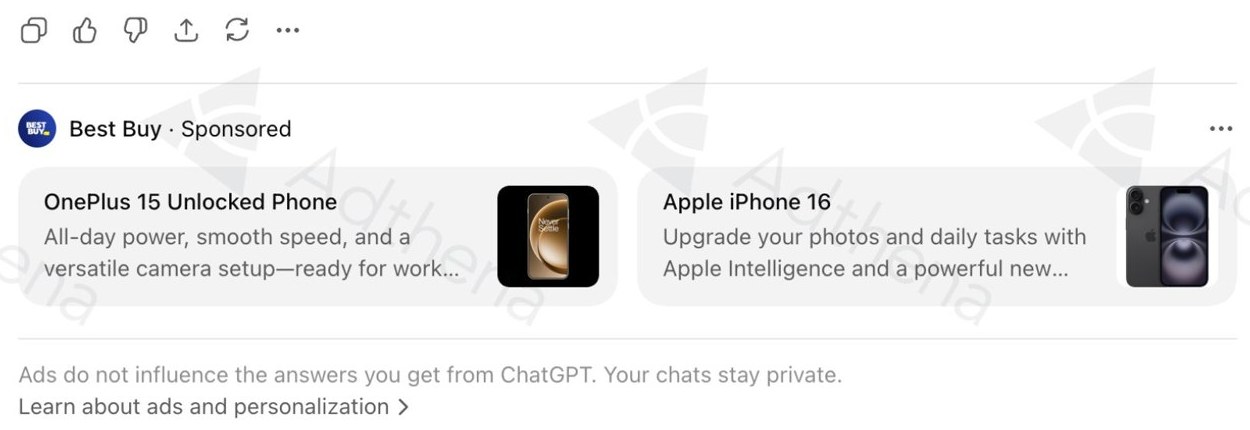
The card sits below the answer with a gray "Ad" chip: your brand name, a headline, a short description and a square image that shows at about 120 px on a phone. There's no button. The whole card links to your page.
One 390-px phone, drawn to scale
The ChatGPT card's image is about 1/14 the area of a Meta feed image
Wide-fit trail shoes
Sizes 7 to 15, free returns for 60 days
- Image on screen
- about 118 x 118 px
- Share of screen width
- 30%
- What has to sell
- Headline and description
Card limits: headline 50 characters (16-24 recommended), description 100 (32-48), square image. Upload 1080 or 1200 px. No button: the whole card links.
So it behaves more like a search ad than a Meta ad. On Meta the image stops the scroll and the copy backs it up. Here the image is a thumbnail, and the headline has to answer the question the person just typed.
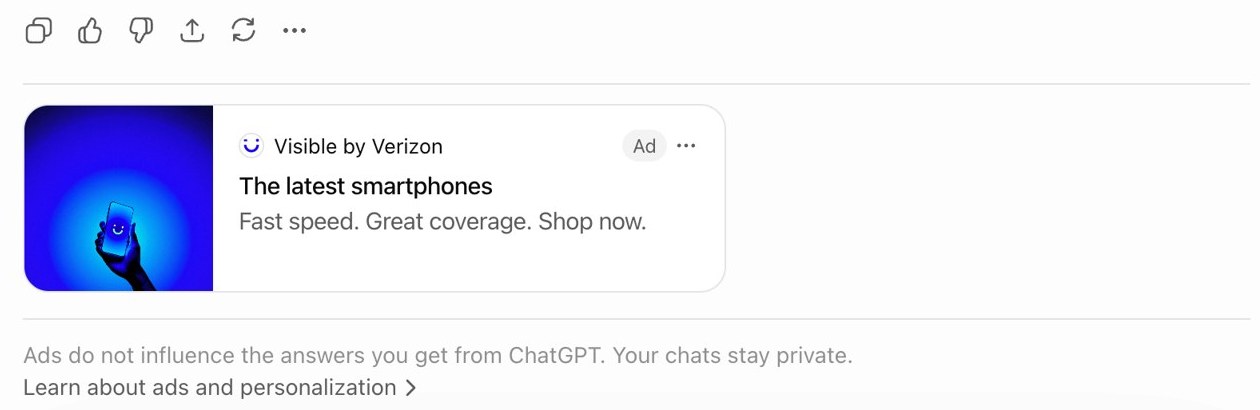
OpenAI said on October 5 that it will test a bigger visual ad, shown while ChatGPT generates an image, in the US later in October. There are no specs and you can't buy it in Ads Manager, so plan around the card.
The card needs a square image that still reads at 120 px. AdMakeAI's AI ad maker turns one product photo into a 1:1 ad image in about 30 seconds. Ask for the product in use and no text in the frame.
Make a 1:1 product imageThe question picks the ad, and only free users see it
Because the card answers a question, OpenAI places it by the conversation, not by who the person is. You give it a landing page and context hints, plain phrases like OpenAI's own example, "After-hours residential plumbing in [city], with an $89 service-call fee for urgent repairs". Hints "are not exact-match keywords", OpenAI says. The model decides what counts as related.
Who gets your card
The question and the user's plan decide. You set neither.
- FreeTrail shoes for wide feet?Ridgeline Running AdWide-fit trail shoes
Close to your hint
- GoWhat should I wear for my first trail 10K?Ridgeline Running AdWide-fit trail shoes
Related. Hints aren't keywords
- FreeMy ankle hurts after runs. What is it?No ad
Personal health: no ads
- PlusBest trail shoes for wide feet?No ad
Paid plans never see ads
You can't target age, gender or interests.
You never see which question showed your ad.
Your own targeting is thin. You can target countries, regions, platforms and custom audiences of 25,000+ matched users, but not age, gender or interests, and the report never shows which questions triggered your ad. And ads only show on Free and Go, logged-out use included. Plus, Pro, Business, Enterprise and Edu users never see one, and OpenAI keeps ads away from personal health, mental health and politics (its help center has the full list).
The free-plan limit is why we're cautious about B2B. The people who sign off on software budgets are the people most likely to use a paid or work ChatGPT plan. The test results below fit that picture.
What seven advertisers paid, and what came back
You can't judge reach or price from a rate card, because there isn't one. You bid for views, clicks or conversions in an auction, and conversion campaigns still bill per click or per impression. OpenAI suggests starting at a $3-5 max CPC and publishes no benchmarks, so the best price data comes from advertisers who posted their own numbers.
Average cost per click, 7 published tests
One test made money: the store with $1,000+ orders
Workshop Digital
B2B agency · $2,319 spent
0 qualified leads
Common Thread Collective
Ecommerce, $1,000+ orders · $9,620 spent
3.3x to 6.8x ROAS
Choice OMG
Agency, Canada
0 leads
Symphonic Digital
B2B agency · ~$500 spent
0 leads
Floyd Blaikie
In-house B2B · ~CA$7,000 spent
0 conversions
Synter
Ad-tech, 5 countries · $4,429 spent
Results not shared
GrowMyAds
Agency · ~$1,200 spent
0 conversions from 92 clicks
Every one of them paid far more per click than Meta's 2025 traffic average of $0.70, and four of seven paid more than OpenAI's suggested bid. Symphonic Digital needed a ~$12 max bid to land ~$9 clicks. Five tests, mostly B2B lead gen, got zero leads. The one that worked was Common Thread Collective's ecommerce client selling $1,000+ orders, at 3.3x to 6.8x ROAS on $9,620. A high order value can carry a $4 click; a demo request mostly couldn't.
OpenAI's customer stories look better (Newegg at 3x ROAS over 28 days, Angi with 34% lower cost per lead), but OpenAI picked them. And expect ChatGPT to report more clicks than your analytics records: Symphonic counted 53 clicks against 35 GA4 sessions. Tag every URL with UTMs.
Write the card as the answer to the question
If the question picks the ad and the image is a thumbnail, the copy is your creative, and it's where most advertisers bring the wrong habits. OpenAI asks for copy that explains "the practical value of what you offer, who it is for, and when it may be helpful, rather than relying on a catchy line or generic call to action." A feed-ad headline fails that and runs too long.
Same product, same card
Write the reply to the question above it
Ridgeline RunningAd
Wide-fit trail shoes
Sizes 7 to 15, free returns for 60 days
In the recommended range
In the recommended range
Headline: what it is plus the detail that decides it, in 16-24 characters.
Description: the next fact (sizes, price, delivery, proof) in 32-48 characters, the important word first.
Several pairs per ad group, each a different angle. OpenAI asks for "a high volume and diverse set of ads". Our free ad copy generator drafts variants you can trim to 24 and 48 characters.
Image: one product or one scene, no logo as the main visual, no text in the frame. Text won't read at 120 px.
Landing page: the product or use-case page, with robots.txt and your firewall letting OAI-AdsBot through, or the ad can't run.
If you sell products, connect a product feed or the Shopify app. OpenAI calls feed ads "among the strongest-performing ads in our program to date."
Who should test, and the first campaign to run
Put together, ChatGPT ads fit when someone would ask ChatGPT to pick a product like yours and your card can answer in one line. Check OpenAI's ad policies before anything else: OpenAI can also decline ads that compete with its own products.
Ecommerce with a product feed or Shopify
Feed ads and the one profitable test both point here.
Local and home services
Hints can carry your area and price, the details people ask about.
B2B selling to budget owners
Your buyers are the likeliest to be on plans that never see ads.
Finance, health or legal outside the US; dating, gambling, alcohol, politics
Banned, or US-only case by case.
Your first ChatGPT campaign
- 1Sign up at ads.openai.com and start business verification now. OpenAI says it can take up to 7 business days.
- 2Objective: Clicks until your OpenAI Pixel or Conversions API events flow, then Conversions. You can't change it after launch.
- 3Budget: daily, $25 minimum in the US. One day can spend up to twice that.
- 4Bid: start at a $3-5 max CPC and expect to raise it.
- 5Ads: 4-6 headline and description pairs, each with a square 1080 x 1080 image.
- 6Tracking: UTMs on every URL, and a weekly check of platform clicks against analytics sessions.
New advertisers get $500 in ad credit after spending $500; it expires after 90 days.
ChatGPT ads FAQ
How much do ChatGPT ads cost?
There's no rate card; you bid in an auction. OpenAI suggests a $3-5 max CPC to start, and seven published tests paid $3.14 to $13 per click.
Is there a minimum spend for ChatGPT ads?
No commitment, but a minimum daily budget of $25 in the US (€15 or £15 in Europe). The $200,000 minimum applied only to the early 2026 pilot.
Does ChatGPT Plus have ads?
No. Ads show on the Free and Go plans, including logged-out use. Plus, Pro, Business, Enterprise and Edu are ad-free.
What size should a ChatGPT ad image be?
Square, 1080 x 1080 or 1200 x 1200, PNG or JPG. The headline can run to 50 characters and the description to 100, but OpenAI recommends 16-24 and 32-48.
Which countries have ChatGPT ads?
Over 60 since September 23, 2026, and you can buy self-serve if your business is billed in one of 63 listed countries, including the US, UK, Canada, Australia, the EU and India.
Does ChatGPT share my conversations with advertisers?
No. OpenAI says advertisers get aggregate views, clicks and conversions only. Settings > Ad Controls turns off ad personalization.
How we got this
OpenAI's announcements, help center, ad policies and developer docs, checked October 10, 2026; dates are OpenAI's. The seven tests were self-published between May and August 2026 by Workshop Digital, Common Thread Collective, Choice OMG, Symphonic Digital, Floyd Blaikie, Synter and GrowMyAds. Most spent under $10,000 and sold B2B, so read them as anecdotes, not benchmarks. The ~120 px image size is our measurement from OpenAI's mockups and one live screenshot. Meta's $0.70 CPC is WordStream's 2025 average.
Make your next ad from what already runs
Research what competitors are running, then generate your own on-brand ads in minutes.