How Much Do Facebook Ads Cost in 2026? Real Numbers, the Budget Math, and Why Yours Look Higher
Facebook ads cost about $0.70 per click and $13-14 CPM globally in 2026, but that average hides a 12x country spread and a learning-phase budget floor most people miss. Here's the real benchmark data, the auction mechanics, and the minimum you actually need to spend.
The honest answer is that Facebook doesn't have prices. It has an auction. The number you pay is decided in the ~100 milliseconds before an ad loads, against every other advertiser fighting for the same person. That said, you came here for a number, so here it is: in 2025 the average click cost $0.70 on traffic campaigns and the average lead cost $27.66, both per WordStream's 2025 benchmark study. The catch is that the same platform charges a dentist $76.71 a lead and a restaurant $3.16, and costs a US advertiser nearly 12x what it costs one selling in India. Averages are where this question goes to die.
Bottom line: Budget around $0.70-$1.92 per click, a $13-14 global CPM (~$20-23 in the US), and a $38 median cost per purchase. The real spending floor isn't Meta's $1/day minimum, it's the learning phase: plan for roughly (target CPA × 50) ÷ 7 per ad set per day. Costs rose ~20% in 2025 and the January 2026 attribution change made them look even higher than they are. The one cost you fully control is the creative, and in the Andromeda era that's also the cheapest lever you have.
2026 Facebook Ad Costs at a Glance
Here are the headline numbers most US and global accounts can benchmark against. These come from large 2025 panels (WordStream's 1,280 US campaigns and Triple Whale's ~35,000 brands), read forward into 2026. Treat them as a starting reference, not a target:
| Metric | 2025 Benchmark | YoY | Source |
|---|---|---|---|
| CPC (traffic) | $0.70 | -6.7% | WordStream |
| CPC (leads) | $1.92 | +2.1% | WordStream |
| CPM (global median) | $13.48 - $14.19 | +20.0% | Triple Whale |
| CPM (US) | $20 - $23 | + rising | Madgicx / SuperAds |
| CPL (cost per lead) | $27.66 | +20.9% | WordStream |
| CPA (cost per purchase, ecom) | $38.17 | +1.0% | Triple Whale |
| CTR (traffic) | 1.71% | +8.2% | WordStream |
| ROAS (median) | ~1.86x | NA | Triple Whale |
Why every article quotes a different CPM:
You'll see Facebook CPMs reported anywhere from $5.61 to $23 in the same week. They're not contradicting each other, they're measuring different things. Gupta Media's low numbers blend in cheap entertainment and reach inventory. Triple Whale's are ecommerce-heavy DTC. WordStream's is global across all industries. A US-only conversion campaign and a global reach campaign can genuinely differ 4x. Find the panel that matches your business and ignore the rest.
Facebook Doesn't Set Prices. It Runs an Auction.
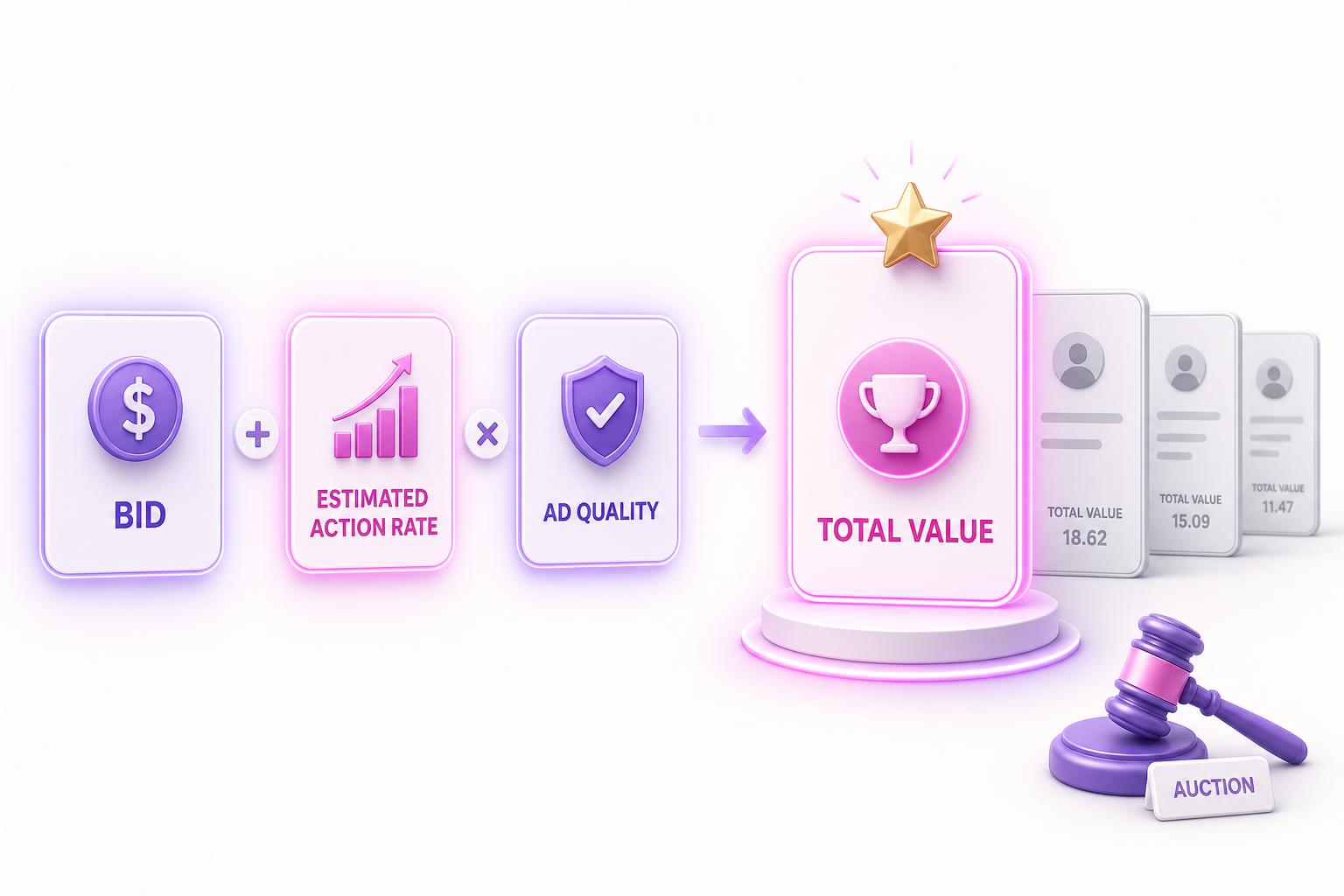
Every time someone opens Facebook, Instagram, or Reels, Meta holds a split-second auction for each ad slot. The winner is not the highest bidder. Per Meta's own documentation, the winner is the ad with the highest total value, which is built from three things:
Your bid
What you're willing to pay for the result you chose. Usually set automatically by your bid strategy, not typed in by hand.
Estimated action rate
Meta's guess that this person takes your action if shown this ad. A high estimate lets a low bid beat a high one. This is where good targeting and creative pay you back.
Ad quality
How users react to the ad: hides, reports, clickbait signals, landing page experience. Low quality drags your total value down even with a big bid.
Two consequences matter for your wallet. First, you don't pay your bid. Meta uses a second-price-style auction, so you pay roughly the minimum needed to beat the runner-up, not your maximum. Bidding aggressively wins you more auctions without making you overpay in the ones you'd have won anyway.
Second, and this is the part founders miss: the estimated-action-rate term means a more relevant, more engaging ad literally costs less to deliver. Two advertisers with identical budgets and audiences can pay wildly different CPMs purely because one's creative earns a higher action-rate estimate. You can't outbid the auction. You can out-create it.
What Actually Determines Your Cost
Seven inputs move the number more than anything else. The first three are mostly outside your control; the last four are where the game is won.
1. Audience competition
The more advertisers bidding for the same person, the higher the CPM. Affluent in-market shoppers and B2B decision-makers are expensive because everyone wants them. Counterintuitively, broad audiences usually cost less than narrow ones in 2026, because Meta can find cheap pockets inside a wide net better than you can describe one.
2. Country and geography
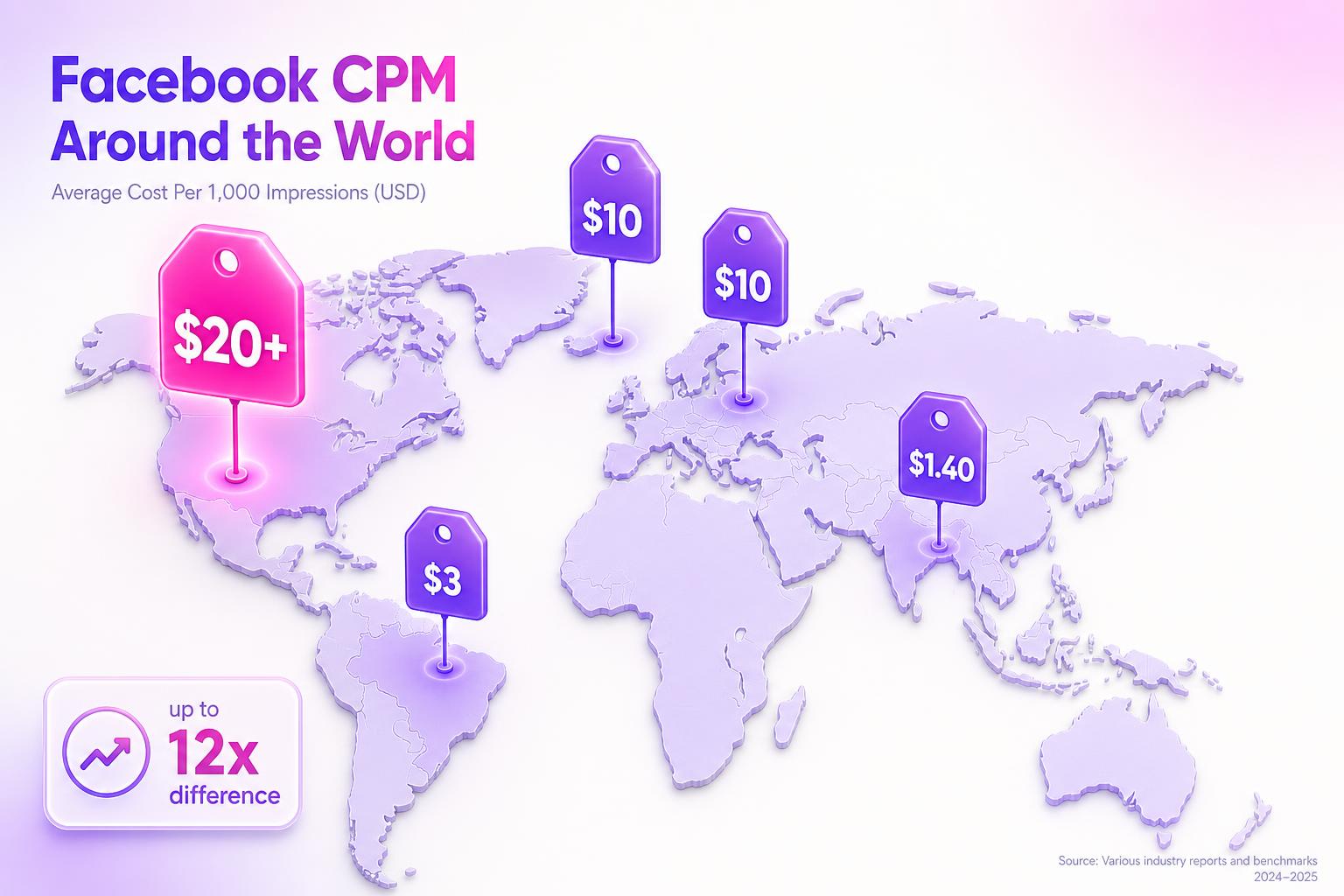
The single biggest lever nobody thinks about. US CPMs run roughly 12x India's. Selling in a Tier 1 country is the main reason your number looks "high" compared to a dropshipper testing in cheap markets. Full table below.
3. Campaign objective
Higher-funnel objectives bid into cheaper inventory; conversion objectives compete for the thin slice of people Meta predicts will buy. That's why a Sales campaign's CPM is roughly 2x a Reach campaign's. Typical US CPM by objective per Affect Group: Reach & Awareness $10-15, Sales (new audiences) $10-15, Lead Gen (website) $25-40.
4. Ad relevance diagnostics
Once an ad clears 500 impressions, Meta scores it on quality ranking, engagement rate ranking, and conversion rate ranking, each against ads chasing the same audience. Slipping to "below average" on any of them is a tax: you bid more to win the same impression. These feed straight into the action-rate and quality terms of the auction.
5. Placement
Each placement is its own sub-auction. Reels and Stories typically run 10-30% cheaper CPM than Feed because supply is growing faster than demand. The desktop Right Column is the cheapest of all and converts the worst. Leave Advantage+ placements on unless you have a hard reason not to, and ship 9:16 creative so you qualify for the cheap slots.
6. Season
The most predictable cost event of the year. November runs ~40% above January as retail floods the auction. More on the Q4 spike below.
7. Creative quality and fatigue
The lever you fully own. Strong creative wins auctions against competitors bidding 2-3x more. As frequency climbs past ~3 and the same users see the same ad, CTR falls, the action-rate estimate drops, and your CPM drifts up while ROAS slides. Most ads show measurable decay within 3-4 weeks if you don't refresh.
Cost by Industry: From $3.16 to $76.71 a Lead
Industry is the second-biggest swing after geography. Here's the 2025 lead-campaign data from WordStream, which shows the spread better than any average can:
| Industry | CPC (leads) | Cost / Lead |
|---|---|---|
| Restaurants & Food | $0.74 | $3.16 |
| Real Estate | $1.57 | $16.61 |
| Arts & Entertainment | $1.08 | $18.17 |
| Education & Instruction | $1.65 | $28.22 |
| Home & Home Improvement | $2.23 | $41.26 |
| Health & Fitness | $2.64 | $52.98 |
| Dentists & Dental Services | $9.78 | $76.71 |
For ecommerce, the more useful number is CPM by vertical. Triple Whale's 2025 panel found every single industry's CPM rose year over year, from +8% (Baby) to +38% (Health & Wellness). Automotive was cheapest at $10.01 CPM; Health & Wellness most expensive at $20.70; Beauty $17.41; Apparel $14.82. If your CPM doubled and you're in wellness or beauty, you're not broken, you're in the most-inflated verticals on the platform.
Cost by Country: The 12x Geo Spread
This is the table that ends most "is my CPM normal?" arguments. The same ad, same creative, same objective costs an order of magnitude more depending on where the impression lands. 2026 figures from Lebesgue and Madgicx:
| Country | Approx. CPM | Tier |
|---|---|---|
| United States | $16 - $23 | Tier 1 |
| Canada | $11 - $14 | Tier 1 |
| Australia | $11 - $12 | Tier 1 |
| United Kingdom | $10 - $12 | Tier 1 |
| Germany | $8 - $10 | Tier 1 |
| Brazil | $1 - $4 | Tier 2/3 |
| India | $1.36 - $2.70 | Tier 3 |
Put differently: a $1,000 daily budget buys roughly 50,000 impressions in the US or 500,000+ in India. This is why a cheap-CPM win can be a revenue loss at the same time, and why comparing your US number to a screenshot from someone selling in Southeast Asia is meaningless. For a deeper breakdown of what an impression even is and how it's priced, see our CPM explainer.
The Q4 Spike: November Costs ~40% More Than January
Meta's CPM follows a predictable annual rhythm: cheap in January, climbing through the year, peaking in November on Black Friday and Cyber Monday auction pressure, then easing in December. Per Gupta Media's tracker, Cyber Monday 2024 hit a $17.70 CPM, about 138% above the annual average. US CPMs in November 2025 ran toward $27 before resetting to the high teens in January, the cheapest window of the year.
The cheap-Q4 trick most people miss:
Per Strike Social, the week around Halloween runs 15-34% cheaper than Black Friday week. Build and warm your audiences in late October when impressions are cheap, then convert them in late November. Front-loading Q4 beats fighting the BFCM auction head-on.
How Much Do You Actually Need to Spend?
Meta will happily let you run a $1/day campaign. It just won't do anything useful. The technical minimums are $1/day for impression objectives and $5/day for click objectives. The number that matters is set by the learning phase: Meta needs roughly 50 optimization events per ad set within a 7-day window to stabilize delivery. Below that, the ad set sits in "Learning Limited" and your costs stay high and erratic.
$5 cost per lead
per ad set
$25 cost per result
per ad set
$40 cost per purchase
per ad set
Most small businesses can't front $286/day, and that's fine. The practical playbook is to consolidate budget into one or two ad sets instead of spreading $30 across five, lean on Advantage+ campaign budget so Meta pools the spend, and pick a cheaper optimization event (add to cart or lead instead of purchase) so you hit 50 events faster. What you cannot do is split a small budget into many ad sets and expect any of them to learn. Target CPA itself is CPC divided by conversion rate, so if you only have one of those numbers, work backwards from a conversion target before you size the budget.
What real businesses spend
Per WebFX, about 63% of businesses spend $500 or less per month, and roughly half of agency-managed accounts spend $500 to $2,000. That low end is telling: a huge share of advertisers are spending below the learning-phase threshold for a conversion campaign, which is exactly why so many conclude "Facebook ads don't work." They weren't given enough budget to ever exit learning.
The cheapest way to lower CPM is better creative, not a bigger budget.
Meta's auction rewards relevant, engaging ads with lower delivery costs, and Andromeda specifically punishes near-duplicate creative. AdMakeAI batches 10 genuinely different ads in one pass, so you can feed the algorithm variety instead of paying the similarity tax. Free credits, no card.
Why Your Costs Look Higher in 2026 (Even If They Aren't)
Some of the 2026 cost increase is real. Some of it is a measurement illusion that almost no other cost article mentions. Both are worth understanding before you panic-pause a campaign.
1. The January 2026 attribution change (the illusion)
On January 12, 2026, Meta removed the 28-day and 7-day view-through attribution windows from its reporting API, defaulting everyone to 7-day click plus 1-day view. Per Seresa and Supermetrics' documentation, reported conversions dropped 15-40% overnight for accounts pulling via the API, with one store's reported ROAS falling from 2.0x to 1.28x while actual orders held flat. If your CPA "jumped" in January, check whether your real revenue actually moved before you touch anything.
2. Andromeda and the creative similarity tax (the real one)
Meta's Andromeda retrieval model, fully rolled out across 2025-26, reads your creative and penalizes repetition. When your active ads are too similar, it treats them as redundant and raises your CPMs. The flip side is the opportunity: brands running genuinely diverse creative consistently report lower costs. This compounds with ordinary creative fatigue, which our CTR benchmarks piece covers in depth.
Real Advertisers, Real Numbers
Benchmarks are tidy. Spending your own money is not. Two founders who documented their Meta spend publicly, and what experienced media buyers say about scaling:
"Cost per click: ranging from $3.50 to $4.80. Cost per actual user: $150-200."
Soyoon Lee, after spending $5,000+ over six months promoting AI SaaS products, Indie Hackers, Jan 2026
Her CPC was 5-7x the benchmark, because SaaS is a competitive, high-intent niche and her budget was too thin to find efficient inventory. The lesson isn't "Facebook is expensive," it's that a small budget on a hard niche buys expensive, noisy data.
"At very low volumes, Facebook scales easily, but we see exponential increases in cost per conversion starting at spends approaching $5,000 per week."
Colette Nataf, Lightning AI, via Databox
The consistent advice from buyers in the same survey: raise budgets by no more than ~25% at a time so you don't reset the learning phase, and treat retargeting as your cheapest inventory. Cost per result isn't a flat line, it's an S-curve, and the marginal cost climbs as you push past what your audience can absorb.
The One Cost You Fully Control
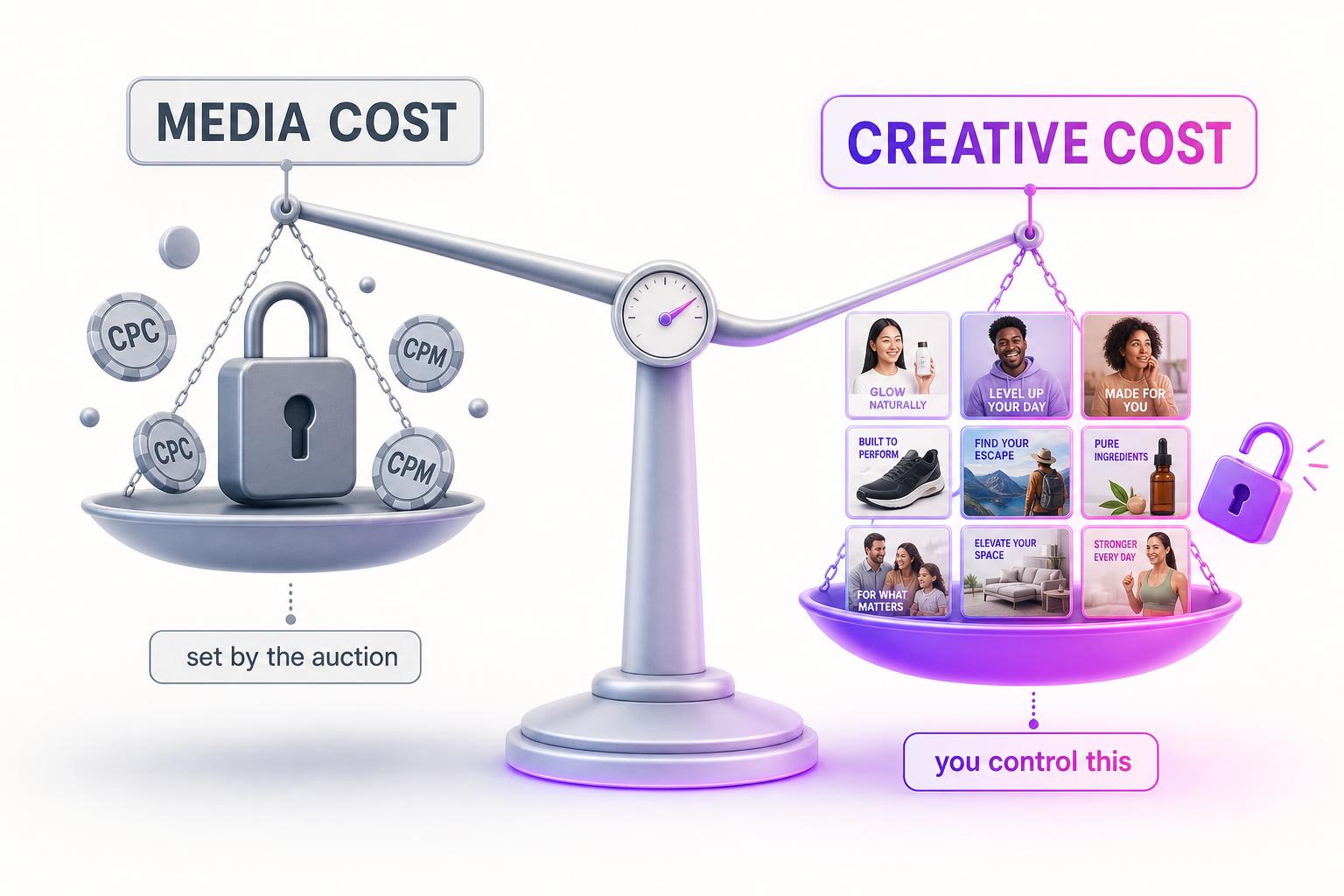
Every cost in this article so far, CPC, CPM, CPA, is decided by the auction. You influence it but you don't set it. There's a second cost most articles ignore entirely: the cost of producing the creative in the first place. That one you control completely, and in 2026 it's where the leverage lives.
Traditional creative is expensive precisely when you need volume. A single UGC video from a proven creator runs $500 to $2,000 once you add usage rights and revisions; a designer-made static is $50-150 a pop. Yet Andromeda rewards feeding the auction 20-50 genuinely different ads a month. At agency rates, that creative bill dwarfs a small business's media budget. AI generation drops the per-asset cost to a few dollars, which is the only way the volume math works without a five-figure production budget.
The reframe: you can't negotiate your CPM down, but you can make every impression you buy work harder with better, fresher creative, and you can produce that creative for almost nothing. In a 2026 where media costs only go up, production cost is the budget line you can actually win.
You can't outbid the auction. You can out-create it.
Lower CPMs come from creative the algorithm wants to show, and from enough variety to dodge the similarity penalty. AdMakeAI generates 30-80 distinct, on-brand ads in the time it used to take to brief one designer. The media cost is Meta's. The creative edge is yours.
Free credits included. No credit card. ~30s per ad.
Frequently Asked Questions
Related Resources
What Is CPM? 2026 Benchmarks
The per-1,000-impression price that sits underneath every other cost, by platform, industry, country, and month.
The Learning Phase Explained
Why 50 conversions is the magic number, and the budget math that decides whether your ad set ever stabilizes.
Boost Post vs Ads Manager
The Boost button often costs 2-3x what the same campaign costs in Ads Manager. Here's when each is worth it.
Ad Set Studio
Batch generate 10 distinct ads at once. Creative variety is the cheapest CPM lever you have in 2026.
Make your next ad from what already runs
Research what competitors are running, then generate your own on-brand ads in minutes.