The Facebook Ads Learning Phase Explained: Why 50 Conversions Is The Magic Number
Meta's algorithm needs 50 conversions per week per ad set to exit Learning Phase. Here's exactly what's happening during those 7 days, what 'Learning Limited' means, why most ad sets never escape, and the 6 specific fixes media buyers use to get through faster.
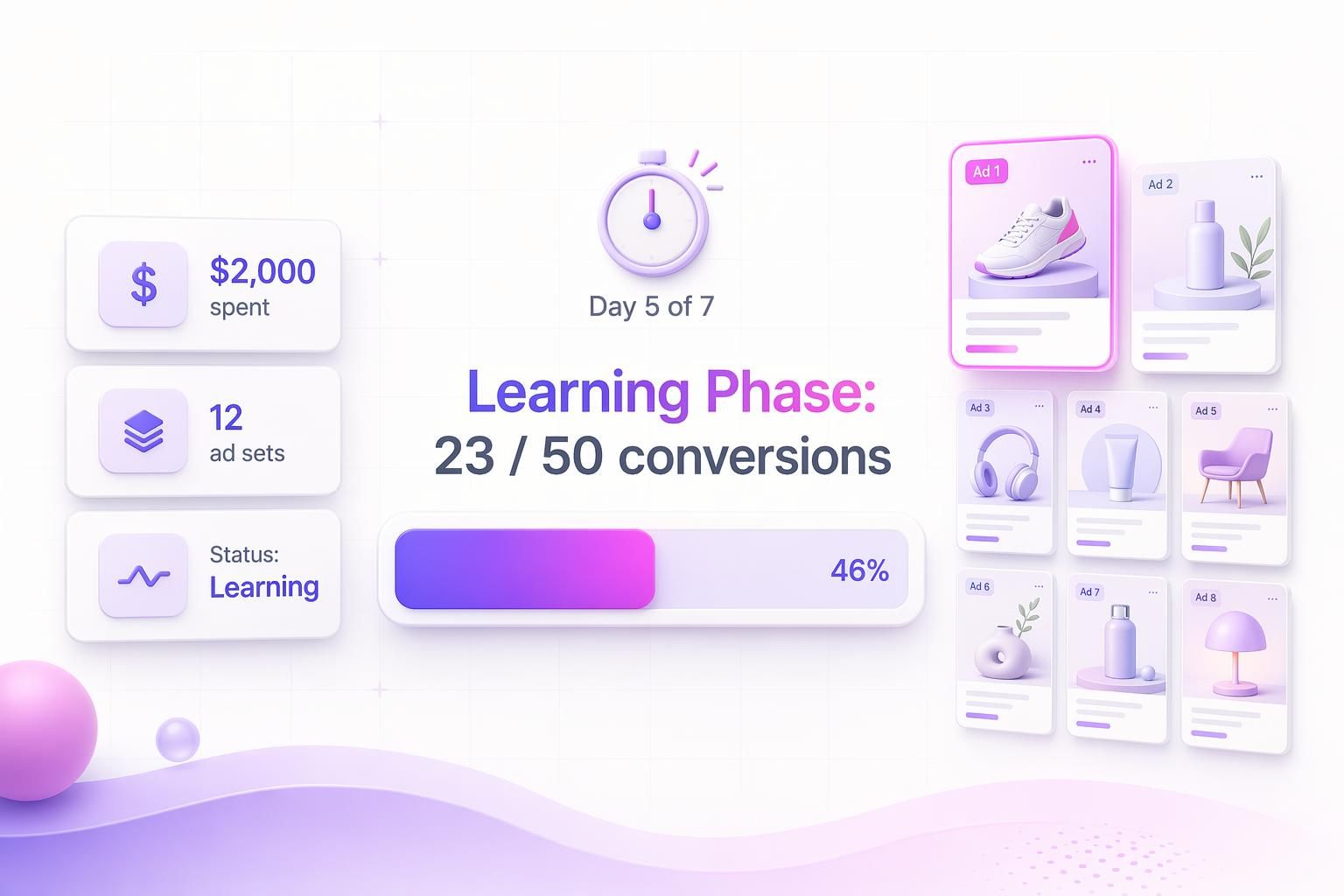
47 ad sets at $85 CPL. Consolidated to 8 ad sets at $34 CPL, in 14 days. Same budget, same offer. The fix was math: 50 conversions per ad set per week was impossible under the old structure and inevitable under the new one. That is this article (Linear Design).
What the Learning Phase Actually Is (And the 7-Day Rolling Clock)
When you launch a new ad set, Meta's delivery system has no idea who converts. It tests audiences, placements, times of day, devices, and creative permutations until it gathers enough signal to optimize. That is the Learning Phase. It happens at the ad set level, not per individual ad, but the ad set has multiple ads contributing signal in parallel.
The 7-day window is rolling, not calendar. If you slow down or pause, you can drop back below threshold and re-enter learning. Per Adligator, during learning your CPA is typically 20-50% higher than the post-learning average.
The 50-Conversion Rule (And The Math Nobody Writes Plainly Enough)
50 optimization events per ad set in a rolling 7-day window (Cometly). The arithmetic:
Minimum daily budget per ad set = (target CPA x 50) / 7
| Target CPA | Weekly Budget Needed | Daily Budget Floor | 10x Heuristic (Agency Norm) |
|---|---|---|---|
| $10 | $500 | $72 | $100/day |
| $20 | $1,000 | $143 | $200/day |
| $40 | $2,000 | $286 | $400/day |
| $80 | $4,000 | $572 | $800/day |
The June 2024 Update Most Advertisers Still Don't Know About
On June 9, 2024 Meta dropped the threshold from 50 to 10 events for Purchase and Mobile App Install campaigns. The UI still shows 50, so most advertisers operate on the old number (Madgicx).
What this means for a $40-CPA Purchase ad set
Old floor: 50 x $40 / 7 = ~$286/day. New floor: 10 x $40 / 7 = ~$57/day. A 5x reduction. For a brand on $100/day, the difference between never exiting learning and exiting in 3 days.
Caveats: it does NOT apply to Mobile App Event campaigns, and rollout has been gradual. Check your specific ad set in Ads Manager, the threshold shown there is the truth for your account.
Learning vs Learning Limited vs Active: The 3 Status Modes
Three delivery statuses, one algorithm. Knowing which one you're in tells you exactly what action to take, or whether to take any action at all.
| Status | What It Means | CPA Behavior | Action |
|---|---|---|---|
| Learning | Accumulating data toward 50 events | Volatile, 20-50% above stable baseline | Wait. Do not touch. |
| Learning Limited | Meta predicts you won't hit 50 events | Decreasing efficiency, vicious cycle risk | Investigate cause. Fix structure. |
| Active | Exited learning, stable delivery | Optimized to target CPA | Scale carefully (under 20% bumps). |
Learning Limited is a warning, not a kill switch, your ads still run (9 Clouds).
The 9 Edits That Reset Learning Phase (The Complete List)
Most articles list five or six. The actual count, synthesized from Triple Whale and Madgicx, is nine. Every single one of them sends your ad set back to zero.
| # | Edit | Why It Resets |
|---|---|---|
| 1 | Budget change >20% | Pacing logic rebuilds (per Triple Whale) |
| 2 | Audience targeting change | Different user pool entirely |
| 3 | Placement change | New auctions, new behavior signals |
| 4 | Optimization event change | Different goal, different model |
| 5 | Bid strategy change | Highest Volume vs Cost Cap are different |
| 6 | Bid cap / cost cap value | Re-bids change auction position |
| 7 | Adding new ads to existing ad set | New creative needs ranking (per Madgicx) |
| 8 | Creative changes inside existing ads | Image, copy, headline, CTA, or URL |
| 9 | Pausing 7+ days then resuming | Stale signal, re-test required |
Usually safe edits (do not reset): budget changes under 20%, renaming campaigns/ad sets/ads, ad scheduling tweaks, short pauses under 7 days, URL parameter changes (though Triple Whale notes this can occasionally reset social proof).
Edit every other day for two weeks = five or six clock resets. The algorithm relearns from zero each time. That is why you are stuck.
Why Most Ad Sets Never Actually Exit (The Two Structural Traps)
Roughly half of campaigns under $100/day never properly exit learning, per the framing in Noble Growth: "Half Your Meta Campaigns Are Stuck in Learning Phase. That's Not a Glitch." Meta's four official causes: small audience, low budget, low bid, too many ads simultaneously. Two failure modes account for almost all of it.
Trap 1: The Under-Funded Ad Set
$30/day budget, $50 target CPA. Math allows roughly 4 conversions per week. The 50-event threshold is 12x what you can produce. You will never exit. Not in week one. Not in week ten.
Fix: raise the floor to (target CPA x 50) / 7 per ad set, or consolidate, or switch to a higher-funnel event.
Trap 2: The Over-Segmented Account
8 ad sets at $25/day each. Total spend looks fine ($200/day). But each ad set generates only 3-5 conversions per week. None of them exit.
Fix: consolidate so each ad set clears the (target CPA x 50) / 7 floor.
The 6 Fixes Media Buyers Actually Use
Ranked by tactical impact. All six confirmed across five or more independent practitioner sources. None of them are secret. They're just rarely all done at once.
Switch to a higher-funnel optimization event temporarily
If you cannot get 50 Purchase events in 7 days, switch to optimize for Add to Cart or Initiate Checkout. Higher-funnel events have 5-15x more volume. At $100/day, you can expect:
- Purchase: 3-15 events/week
- Add to Cart: 15-60 events/week
- View Content: 50-200 events/week
- Link Click: 200-1,000 events/week
Volumes per AdsGo. Switch back to Purchase once you exit learning, lower-funnel events bring lower-intent users.
Consolidate ad sets (the "fewer, bigger" rule)
Combine 5 fragmented ad sets into 1 or 2. Each one now hits 50 events on its own instead of starving. A $10M+ practitioner cited via AdStellar sums it up: "consolidate your budget into fewer ads, set a higher bid cap, or switch to a broader audience."
The math from Cometly: $200/day across 4 ad sets generates ~14 conv/week per set (below threshold). Consolidated to 1, it's ~56/week (above threshold).
Use Advantage Campaign Budget (CBO) to pool conversions
CBO lets Meta funnel spend to the winning ad set, accumulating 50 events faster than rigid ABO splits across losers.
Per Niblin: "CBO often exits learning faster because Meta can shift budget to the best-performing ad set, accumulating 50 events faster."
Budget to the math (and never scale >20% at once)
Target CPA x 50 / 7 = minimum daily budget. Below that floor, you cannot math your way to 50 events in 7 days.
Scaling rule: increase by 10-20% every 3-4 days. Jumps above 20% trigger a reset.
Run 6+ creatives per ad set, each one generates its own signal
Inside a single ad set, Meta tests every ad and gathers signal on all of them. 6 ads in 1 ad set = 6 simultaneous data streams contributing to the ad set's 50-event quota. 1 ad in 1 ad set = a single point of failure.
Critical constraint per Madgicx: bulk-launch all ads at the same time. Adding ads later resets learning. Load 5-6 at launch, activate 2, leave others paused, rotate. Rotating between existing ads does NOT reset.
The "no touch" rule for the first 7 days
Set a calendar reminder. Do not touch the ad set for 7 days minimum, 14 ideally. Bundle any required edits and do them all at once so the algorithm only relearns once.
Per Thread Transfer: "Set a rule for yourself: no edits for 7 days minimum, ideally 14. Let the algorithm stabilize."
1 ad set with 25 creatives beat 5 ad sets at 5 each by 17% conversions and 16% lower cost (Meta's own data).
AdMakeAI's Ad Set Studio generates 10-25 variations per batch. Pooled signal across ads, faster learning exit, no fragmented ad-set sprawl. Bulk-launch them all at once so adding doesn't reset learning. Free credits, no card.
Advantage+ Shopping (ASC): Different Structure, Faster Exit
Same 50/7 threshold technically applies, but ASC consolidates targeting, placement, and creative into a single optimization pool. The result: it usually hits 50 events faster than a fragmented ABO/CBO structure. Per Modern Marketing Institute, ASC typically exits learning 15-30% faster than ABO for the same spend.
The catch: creative volume requirements for ASC escalate hard with spend. Per Adligator and Alex Neiman:
| Daily Spend | Minimum Creatives Per Ad Set | Why |
|---|---|---|
| $100-300 | 10-15 | Floor for ASC to have routing options |
| $300-1,000 | 20-30 | Faster fatigue, more diversity needed |
| $1,000-5,000 | 30-50 | High impression volume burns creative quickly |
| $5,000+ | 50-100+ | Tribe-level segmentation at creative level |
Thin creative library = ASC plateaus.
Quick Answers
Bulk-load 6+ creatives at launch. The single biggest learning-phase lever.
Each creative inside an ad set is its own signal stream feeding the 50-event quota. Ad Set Studio bulk-generates 6+ variations per concept in around four minutes, then bulk-uploads so adding them later doesn't reset learning.
Related Resources
The Creative Volume Wall in Meta Ads
Why Loop ships 500 concurrent ads while you ship 10, and the math that makes it inevitable.
Higher CTR Facebook Ads in 2026
The Andromeda + creative-as-targeting playbook that pairs with this learning-phase tactic.
How Many Facebook Ad Creatives Should You Test?
The complete guide to creative testing volume by budget.
Why Winning Ads Die After 2 Weeks
Creative fatigue once you exit learning, and how to extend ad lifespan with volume rotation.
Competitor Intelligence
See exactly which creatives competitors loaded into their ad sets at launch.
Make your next ad from what already runs
Research what competitors are running, then generate your own on-brand ads in minutes.