How Many Facebook Ad Creatives Should You Test? The Complete Guide
Stop guessing how many ad variations to run. Learn the exact number of Facebook ad creatives to test based on your budget, plus frameworks used by 7-figure ecommerce brands.
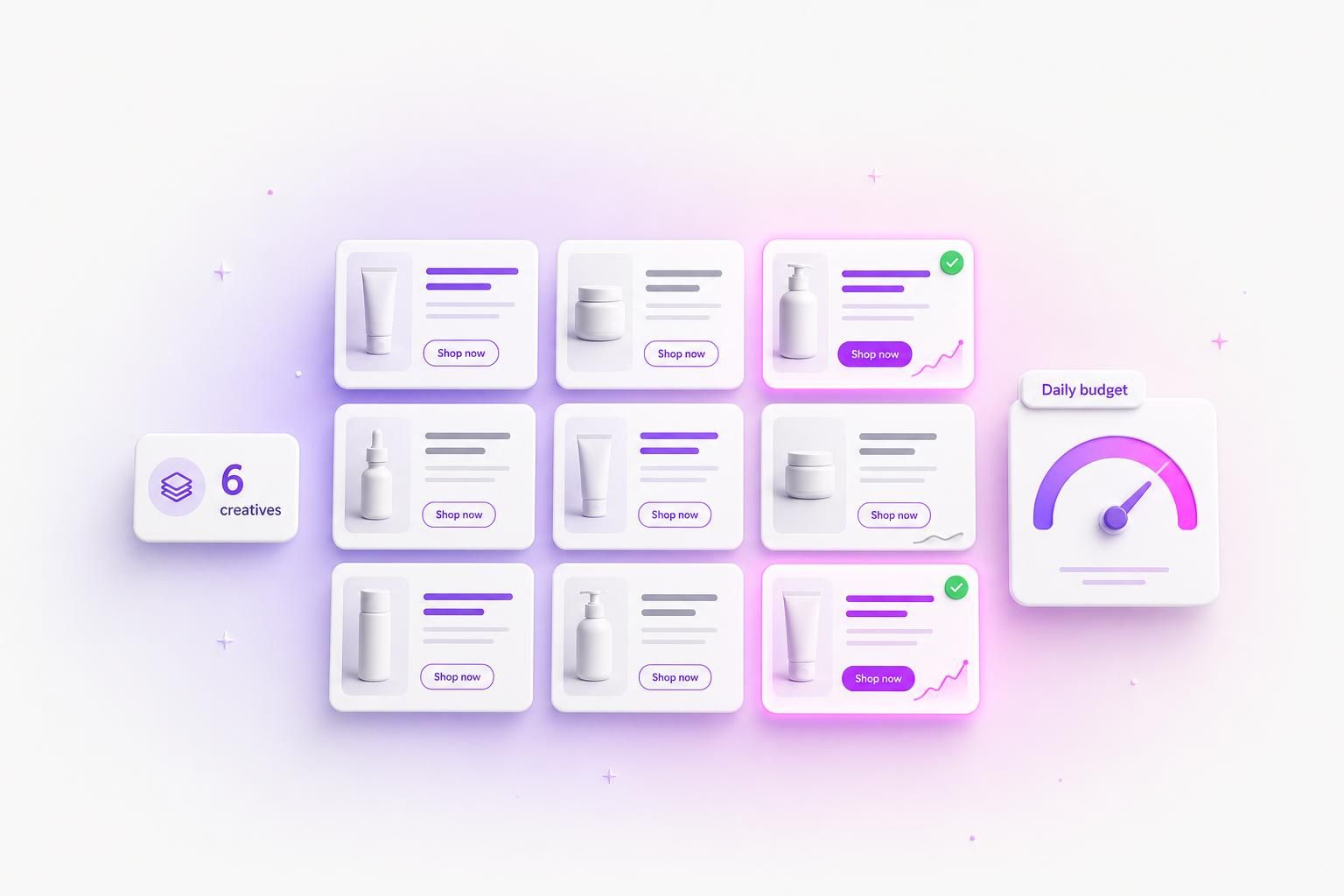
"How many ads should I be testing?" It's the question every Facebook advertiser asks - and gets a different answer every time. Some gurus say 3-5 per ad set. Others recommend 50 new creatives per month. The truth? It depends on your budget, and most advice out there is designed for brands spending $50K+/month. Here's what actually works at every budget level.
The Bottom Line: Creative is the #1 factor in your Facebook ads success - it accounts for 56% of campaign ROI. But more creatives isn't always better. Testing too few means missing winners. Testing too many wastes budget on inconclusive data.
The Real Numbers: Testing Volume by Budget
Let's cut through the noise. Here's what the data actually shows for creative testing volume based on monthly ad spend:
| Monthly Ad Spend | New Creatives/Month | Test Budget (%) |
|---|---|---|
| Under $5K | 5-10 | 20-25% |
| $5K - $25K | 15-25 | 20-30% |
| $25K - $50K | 25-40 | 25-30% |
| $50K+ | 50+ | 20-30% |
The 50-per-$25K Rule:
A common benchmark is testing ~50 new ads for every $25,000 in monthly ad spend. This gives you enough data to identify winners while not spreading budget too thin.
If you're spending $2,000/month on ads, testing 50 creatives means each one gets roughly $40 of spend - nowhere near enough to determine if it actually works. You'd be better off testing 5-8 creatives properly.
Why "3-5 Ads Per Ad Set" is Outdated
You've probably heard the advice: "Run 3-5 ads per ad set to let Facebook optimize." This made sense years ago. Today, it often backfires.
The Problem:
When you put multiple ads in a single ad set, Facebook picks a "winner" too quickly - often before any ad has enough data to prove itself. The algorithm might declare Ad A the winner after just 500 impressions, then funnel 95% of budget to it while Ads B-E never get a fair chance.
A/B test data shows that running 1 ad per ad set often delivers better results than stacking multiple ads together. Why? Each creative gets fair testing, faster learning, and you get cleaner data on what's actually working.
The Modern Approach: Isolated Creative Testing
- 1 creative per ad set for accurate performance data
- Multiple ad sets with identical targeting, different creatives
- Minimum $50-100/day per ad set to exit learning phase
- 7+ days before making decisions
What to Test: The Creative Variables That Matter
Not all creative tests are created equal. Some variables have massive impact. Others are barely worth testing. Focus your limited testing budget on the elements that move the needle:
High Impact (Test First)
- • Hook/opening (first 3 seconds)
- • Format (static vs video vs carousel)
- • Angle (benefit, problem, social proof)
- • Visual style (UGC vs polished vs product)
- • Headline/primary text
Lower Impact (Test Later)
- • Color variations
- • Font changes
- • CTA button text
- • Minor copy tweaks
- • Background variations
The One-Variable Rule:
When testing, change only one element at a time. If you test a new image AND new headline AND new format simultaneously, you won't know which change drove the results. Isolate variables to build real learnings you can apply to future creatives.
Static Images vs Video: What Actually Performs Better?
This is one of the most common questions in Facebook advertising - and the answer might surprise you.
The Data:
- Video ads get ~480% more clicks than static images (1.87% CTR vs 0.43% CTR)
- But video CPMs are significantly higher - sometimes 2-3x
- Static images often have higher conversion rates and lower cost per purchase (up to 24% lower)
Translation: Video wins the attention game. Static images often win the conversion game. The best strategy? Test both, but don't assume video is automatically better just because it gets more engagement.
Pro Strategy:
Use video for top-of-funnel awareness and retarget clickers with static image ads optimized for conversion. Video warms them up, static closes the sale.
Creative Fatigue: When Winning Ads Stop Winning
Every winning ad eventually dies. The audience gets tired of seeing it, engagement drops, and costs rise. This is creative fatigue - and it's why you need a constant pipeline of new creatives.
Signs of Creative Fatigue:
- Frequency above 3 (people seeing your ad 3+ times)
- CTR dropping week over week
- Cost per result increasing while nothing else changed
- Facebook shows "Creative Limited" or "Creative Fatigue" status
The typical lifespan of a winning Facebook ad creative is 2-4 weeks before fatigue sets in. For smaller, targeted audiences, it can be even faster. This means you need fresh creatives ready to rotate in constantly.
Beating Fatigue: The Iteration Method
When a creative starts fatiguing, don't abandon it entirely. Create variations:
- Same concept, different visual treatment
- Same hook, different product angle
- Same testimonial, different format (static → carousel)
- Same offer, different headline emphasis
A Simple Testing Framework That Works
Here's a practical framework for creative testing that works whether you're spending $2K or $200K per month:
The 70/20/10 Creative Split:
- 70% - Proven winners: Your best-performing creatives and variations of them
- 20% - Iterations: New versions of winning concepts with one variable changed
- 10% - Wild cards: Completely new concepts, formats, or angles you haven't tried
This balance ensures you're scaling what works while continuously testing for the next breakthrough creative. Most brands fail by going all-in on either extreme - either milking one winning ad until it dies, or constantly testing random new ideas without building on winners.
Weekly Testing Rhythm:
- Monday: Review last week's test results
- Tuesday-Wednesday: Create new test creatives
- Thursday: Launch new tests
- Friday: Scale winners, pause losers from previous week
Where to Find Winning Creative Ideas
The fastest path to winning creatives isn't starting from scratch - it's studying what's already working in your market.
Research Sources for Creative Inspiration:
- Facebook Ad Library: See every active ad from any competitor (it's free)
- Competitor analysis tools: Find ads that have been running longest (longevity = profitability)
- Your own organic content: Posts that performed well organically often make great ads
- Customer reviews: Real language your customers use makes powerful ad copy
- Reddit/forums: See how people actually talk about problems your product solves
When researching competitors, look for ads that have been running for weeks or months. If someone's running the same ad for 60+ days, it's almost certainly profitable. Study the format, hook, and angle - then adapt it for your brand.
The Real Problem: Creative Production Speed
Here's the uncomfortable truth: most brands know they should be testing more creatives. The bottleneck isn't strategy - it's production capacity.
The Production Problem:
Creating quality ad creatives is time-consuming. Hiring designers is expensive. Most small and mid-sized brands end up testing far fewer creatives than they should - not because they don't know better, but because they can't produce enough.
This is exactly why AI ad tools have exploded in popularity. The ability to generate multiple ad variations quickly changes the game for brands that were previously limited by production capacity.
Your Action Plan
Quick Reference:
- Under $5K/month: Test 5-10 creatives, focus on high-impact variables
- $5K-$25K/month: Test 15-25 creatives, start building iteration systems
- $25K+/month: Test 40-50+ creatives, use the 70/20/10 framework
- Always: 1 creative per ad set, 7+ days before decisions, isolate variables
The brands winning on Facebook in 2025 aren't the ones with the biggest budgets - they're the ones with the best creative testing systems. Start small, build your process, and scale what works. Your next winning creative is one test away.
Need More Ad Creatives to Test?
Generate scroll-stopping ad images in seconds with AI. Research competitors, find winning concepts, and create variations at scale.
Free credits included • No design skills needed
Related Resources
Ready to create winning ads?
Research what competitors are running, then generate your own on-brand ads in minutes.