Facebook Ad CTR in 2026: Why Yours Looks Broken (And 9 Creative Levers That Still Move It)
Meta's March 2026 attribution change and Andromeda algorithm rewrote what CTR means. Here's what actually changed, why your metrics look worse, and the 9 creative levers ad buyers are using right now to get 30-45% hook rates.
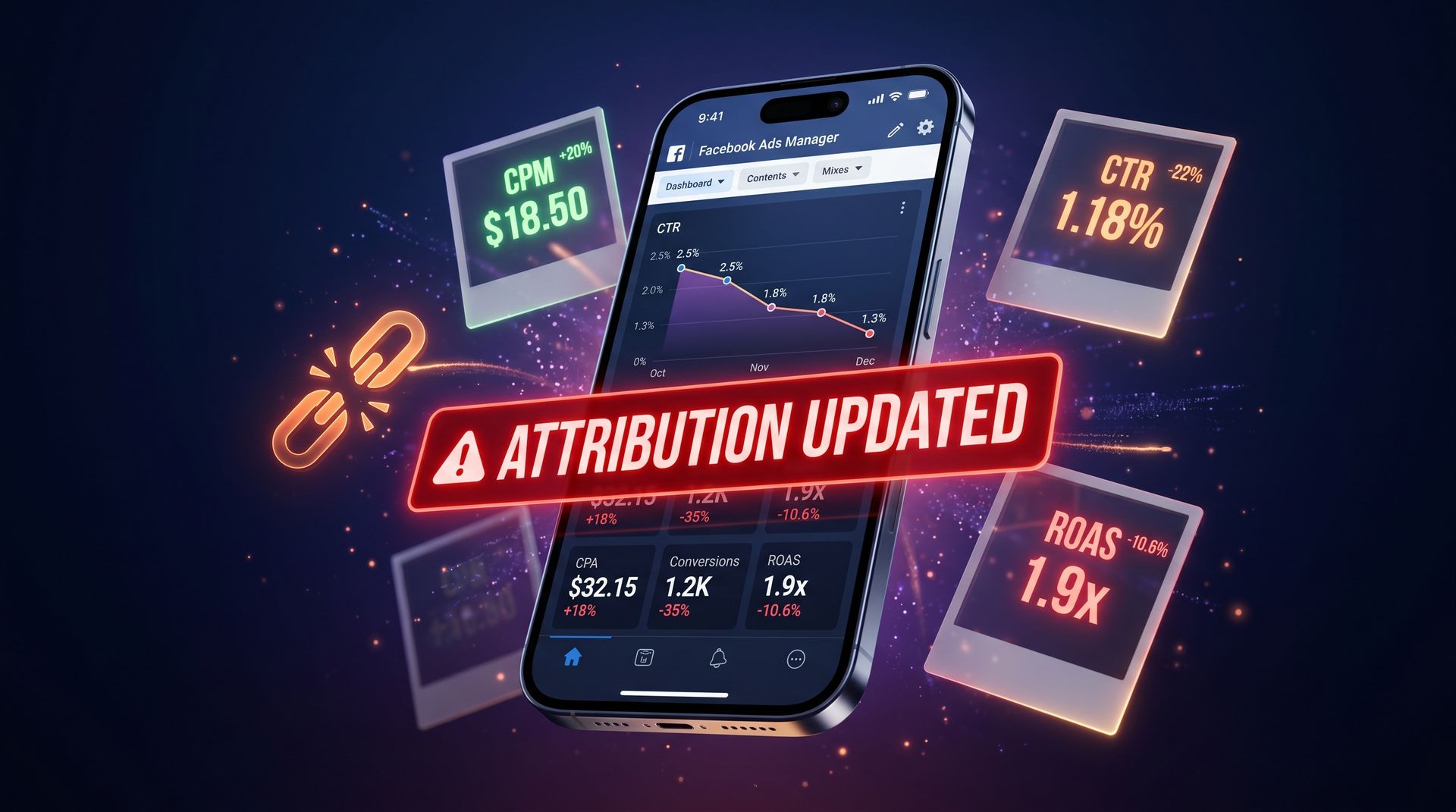
You opened Ads Manager Monday morning and the numbers made no sense. Same creative that ran all February. Same landing page. Same audience. But CTR is down 22%, CPM jumped from $11 to $14, and the ROAS column looks like someone replaced the decimal. You didn't change anything. Meta did. On March 3, 2026, they changed what a "click" even means, and a lot of the conversions you thought you had simply stopped showing up in your reports.
The Bottom Line: Two things broke Meta's CTR reporting this year: click-through now requires an actual link click (likes, saves, and expands stopped counting), and engage-through was capped at a 1-day window, down from 7. On top of that, Meta's Andromeda algorithm, running on NVIDIA GH200 superchips at 100x speed, quietly rewrote how ads get matched to people. Your CTR isn't worse. Your reporting is narrower, and your creative is now doing 90% of the job that targeting used to do.
What Actually Changed in March 2026
Meta made two big announcements this quarter, and they compound on each other in ways most dashboards don't surface. If you understand these, your "performance drop" suddenly becomes a reporting shift you can work around.
1. Click-through attribution was narrowed (March 3, 2026)
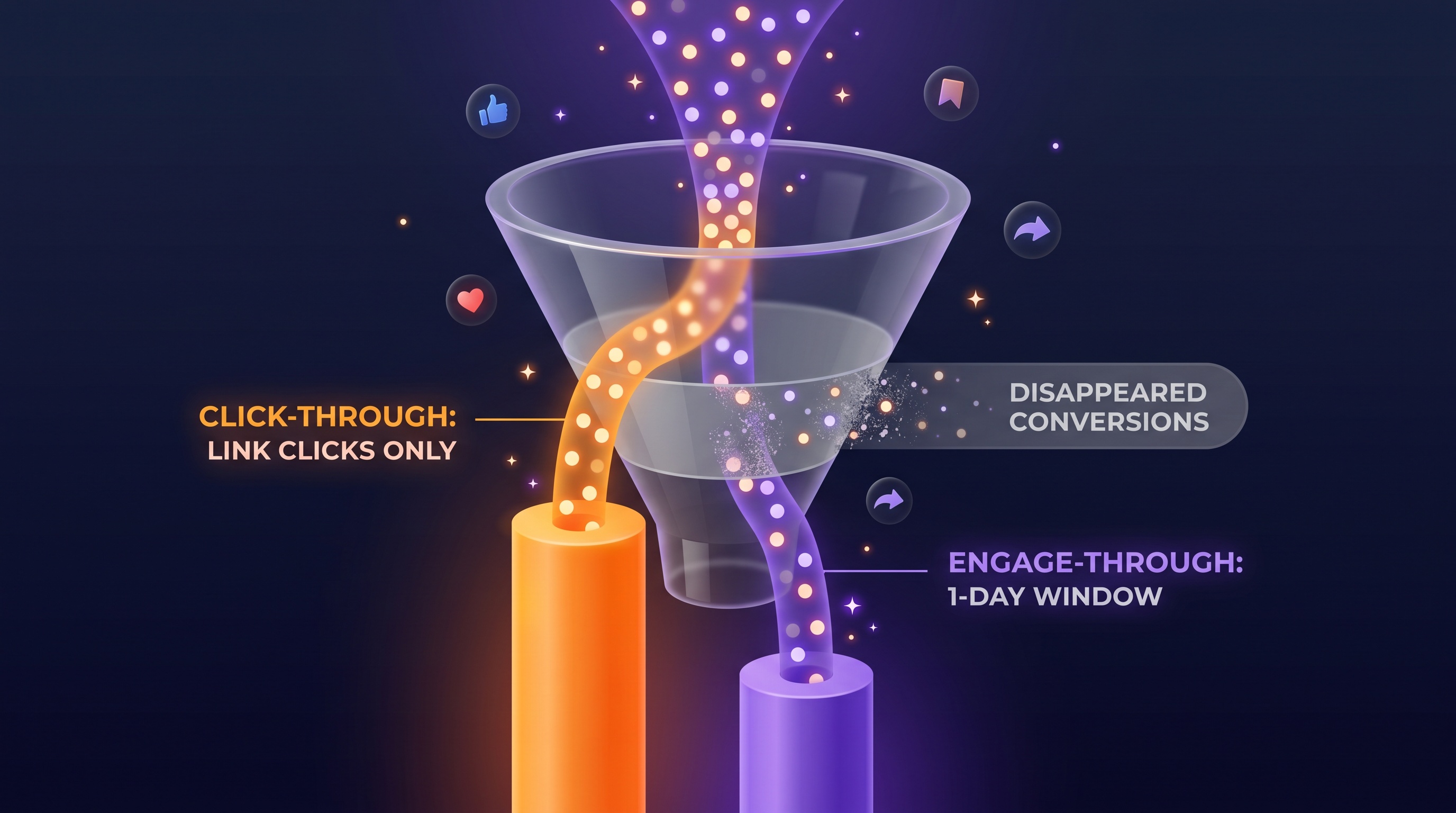
Before March: a "click" could be a like, reaction, share, save, comment, image expand, or a 10+ second video view. After March: only an actual link click, one that sends someone to your site, app store, or lead form, counts toward click-through attribution.
Meta's own wording: "Going forward, we are changing the definition of click-through attribution for website and in-store conversions to exclusively include link clicks."
2. Engaged-view became engage-through, with a 1-day window
All those non-link interactions (likes, saves, comments, and now video views at 5 seconds instead of 10) moved to a renamed bucket called engage-through attribution. But the conversion window collapsed: where engaged-view used to look back 7 days on video, engage-through looks back only 1.
The practical effect: a conversion that happens 4 days after someone watched your video but didn't click now shows up in neither bucket. It's not in click-through (no link click). It's past the 1-day engage-through window. It just disappears from your report.
3. Andromeda went global (early 2026)
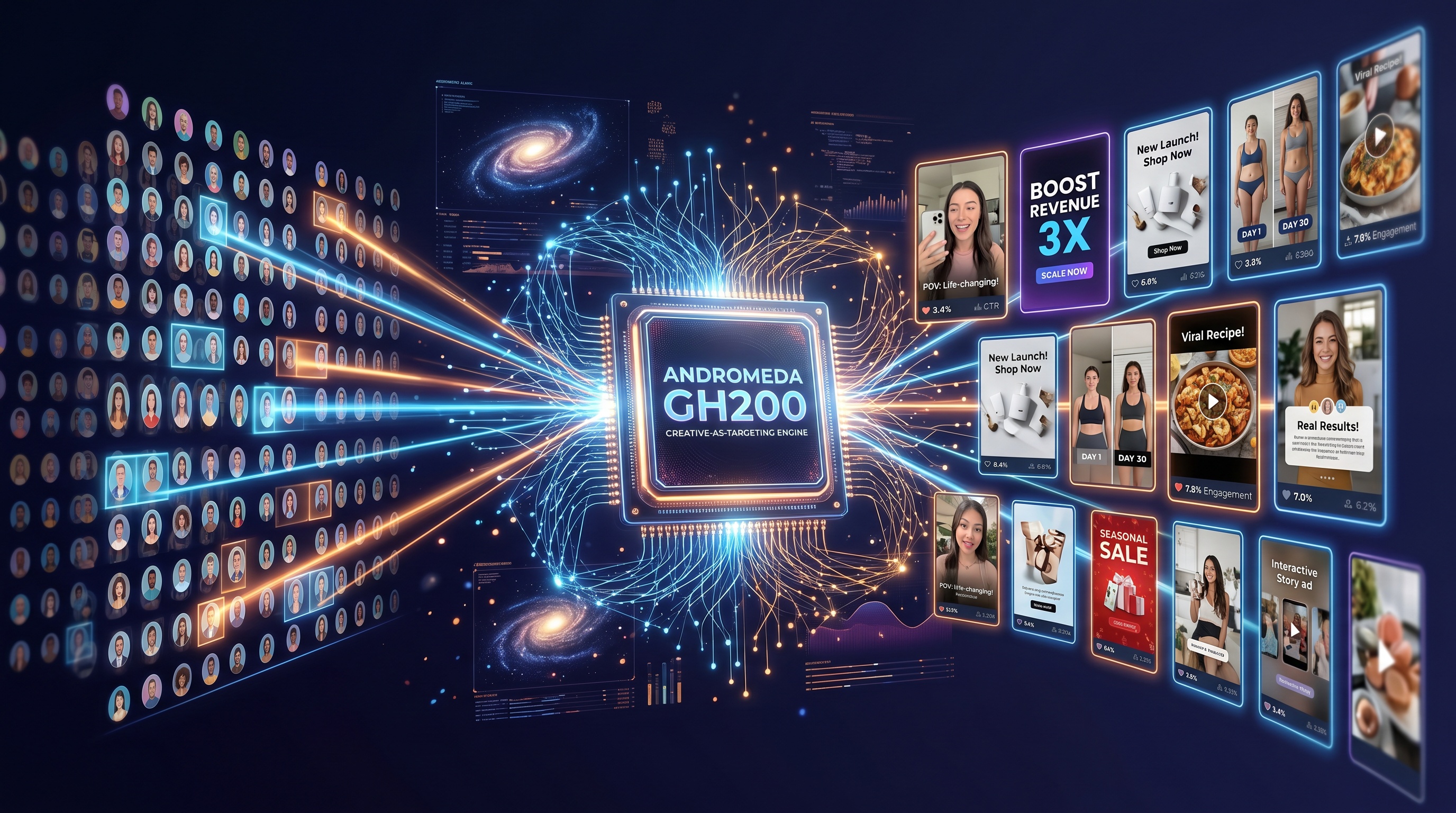
Meta's ad retrieval engine, Andromeda, runs on NVIDIA's Grace Hopper (GH200) superchips. It's 100x faster at matching users to ads and processes 10,000x more ad variants in parallel than the previous system. It narrows tens of millions of active ads down to thousands of candidates for any given user, every time they open Facebook or Instagram.
The quote advertisers are circulating: "Andromeda does not optimize for novelty. It optimizes for semantic meaning." Translation: the system reads your creative (the colors, the text overlay, the first 2 seconds of motion) and uses that as targeting signal. Your creative is your audience now.
Nick Shackelford (managed $200M+ in Meta spend):
"Audience marketing is nearly dead. Creative is almost all that matters. Creative is the new targeting." If you want to reach golfers, you don't build a golfer audience. You make a video that calls out golfers in the first 2 seconds and let Andromeda route it to them.
Why Your CTR Looks Worse Even Though Your Ads Are the Same
The gap between what your ads did and what your dashboard shows widened in March. Agency reports comparing Q1 2025 to Q1 2026 show the damage in hard numbers:
| Metric | Q1 2025 | Q1 2026 | Change |
|---|---|---|---|
| Average CPM | $11.23 | $13.48 | +20.0% |
| Average CPA | $27.65 | $30.00 | +8.5% |
| Cost per Lead | $22.87 | $27.66 | +20.9% |
| Average ecom ROAS | 3.12x | 2.79x | -10.6% |
| Advantage+ Shopping ROAS | 4.80x | 4.52x | -5.8% |
Here's the nuance agencies are shouting about: a chunk of that CPA and ROAS shift isn't performance decline. It's measurement correction. Zentric Digital's analysis of Q1 accounts found that the new attribution rules inflated reported CPAs by 15-30% on average without any actual change in real conversions.
What one agency wrote to clients on March 18:
"Your Meta ads didn't break in March 2026. Your measurement did. Stop comparing April numbers to February numbers. The unit of measurement literally changed. Reset your baseline using only post-March 15 data."
If you're optimizing campaigns against a pre-March CTR target, you're chasing a number that doesn't exist anymore. The first move isn't a creative refresh. It's a baseline reset.
The New 2026 Benchmarks (Hook Rate, Hold Rate, CTR)
Motion's 2026 Creative Benchmarks report analyzed 550,000+ ads across $1.3 billion in spend from 6,000+ advertisers between September 2025 and January 2026. A few numbers worth tattooing on your wall before you optimize anything:
The 50 / 44 / 6 Rule
- ~50% of ads in any account receive minimal or no spend. The algorithm kills them before they can learn
- ~44% of ads spend meaningfully but don't become winners
- ~6% of ads account for the majority of account spend. These are the real winners
- Only ~5% of ads qualify as statistically significant winners (spending 10x the account's median single-ad spend)
| Metric | Baseline (Table Stakes) | Good | Elite |
|---|---|---|---|
| Hook rate (3s view / impressions) | 25% | 30% | 40%+ |
| Hold rate (15s view / 3s view) | 10% | 15% | 25%+ |
| CTR (link clicks, post-March) | 0.9-1.2% | 1.5-2% | 2.5%+ |
| Static image CTR (DTC) | 1.2% | 2.0% | 3%+ |
| Creative lifespan before fatigue | 2-3 weeks | 4 weeks | 6+ weeks |
A note on static vs video:
Despite every TikTok-native consultant pushing video, static images still drive 60-70% of DTC conversions on Meta in 2026. They have lower CPMs, don't require a "hook" to survive the scroll test (the whole image is the hook), and Andromeda treats them as first-class citizens. Don't abandon static. Test it first, then scale with video.
The First-Frame Science: Why 73% of Video Ads Die in 3 Seconds
Motion's analysis of those 550,000+ ads surfaced a brutal pattern: the single biggest determinant of whether an ad becomes a winner is whether its first frame looks like an ad. If the opening shot reads as branded content (logo center frame, studio lighting, a product hero shot, a graphic with a headline), it fails the scroll test. And 46% of Reels purchase conversions, according to Meta's own research, happen within the first 2 seconds of user attention. You literally have less than 2 seconds.
First-frame patterns that FAIL:
- Logo on screen at t=0
- Clean studio product shot with white background
- Slow zoom-in or pan across the product
- Text overlay with the brand name first
- Generic stock-video opening (city skyline, hands typing)
- Title card introducing the video
- Any shot that looks "directed"
First-frame patterns that WIN:
- Selfie-framing mid-sentence ("Okay, so...")
- Hand grabbing the product out of frame
- Bold text on a flat color that names the viewer
- Pattern-interrupt visual (unexpected angle, weird prop)
- Before/after split with zero setup
- Mid-reaction face (shock, laugh, disgust)
- A DM or text message screenshot
According to Motion's 2026 breakdown, five hook formats dominated ads at accounts spending $1M+ per month:
Confession
"I used to spend $300/mo on [category] until I figured out..."
Bold claim
"This is the only [X] a [type of person] will ever need."
Relatability
"POV: it's Sunday and you just remembered [problem]."
Contrast
Side-by-side "what I was doing" vs "what I do now" in under 1 second.
Curiosity
"Don't buy [category] until you see this [prop/test]."
The cheat code
Andrew Foxwell's takeaway: text-only ads and plain product images with overlays are consistently in top-performer lists, and they're the cheapest to produce at scale.
9 Creative Levers That Still Move CTR Post-Andromeda
Each of these has a real source, a specific tactic, and a benchmark so you know what "working" looks like. Do these in order. The first three cost nothing and usually fix a 20% CTR deficit on their own.
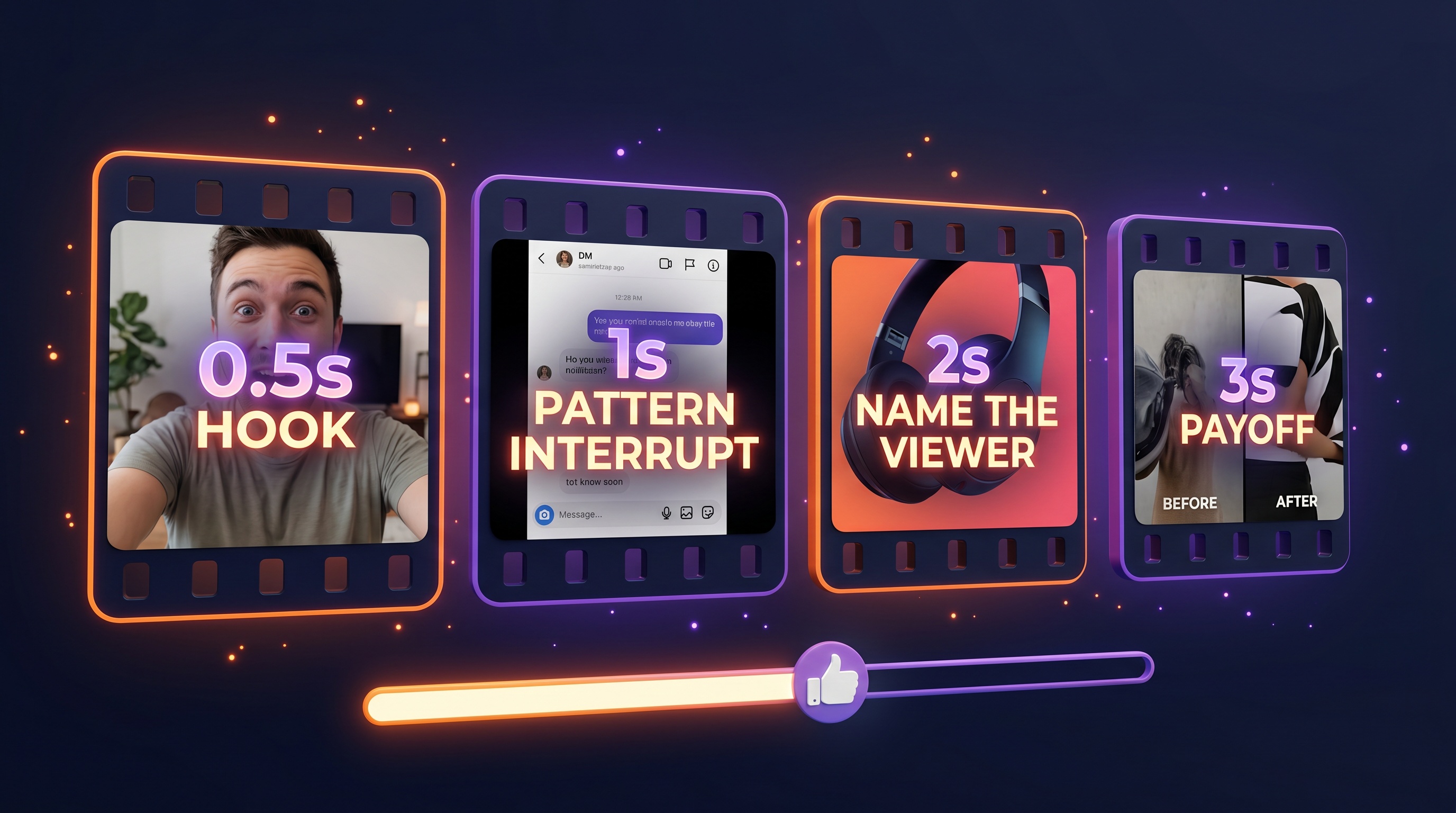
1. Kill the first 0.5 seconds of every video
Open your current top performer in a video editor and chop 0.5-1.0 seconds off the front. Re-upload as a fresh ad. Most "failed" hooks are actually fine. They just start too slow.
Source: Barry Hott (has analyzed $100M+ in ad spend). Benchmark: expect a 15-25% hook rate lift on the same content.
2. Name the viewer in the first 2 seconds
Because Andromeda reads your creative as a targeting signal, the words "if you're a [nurse / dog owner / someone who sits all day]" in the first 2 seconds don't just grab attention. They tell the algorithm exactly who to show this to.
Source: Nick Shackelford's "creative is the new targeting" framework. Benchmark: named-audience ads consistently hit 35%+ hook rate on cold traffic.
3. Run the $100 static-first test
Before spending $2,000 on a UGC shoot or a video, test the angle as a single static image for under $100. If the static can't clear a 1.5% CTR cold, the angle is bad. No amount of production will save it.
Source: Nick Shackelford ($200M+ managed Meta spend). Benchmark: a passing static = 1.5%+ link CTR at $50 spend against a cold audience.
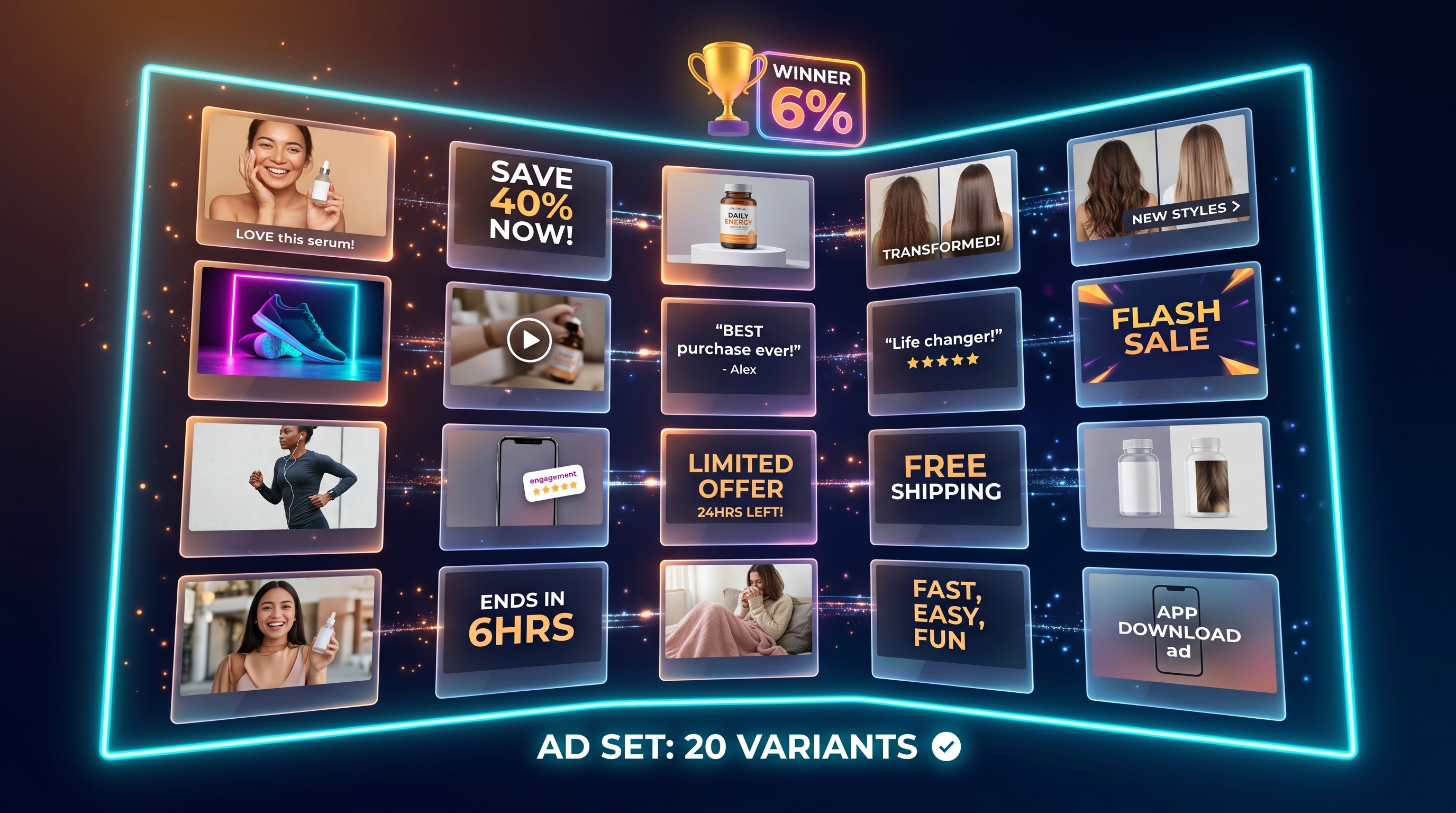
4. Load the ad set with 10-20 creative variants
Meta's own data: 1 ad set with 25 creatives beats 5 ad sets with 5 creatives by 17% more conversions at 16% lower cost. Andromeda needs diversity: not variations of the same video, but actually different formats, styles, and angles in the same ad set.
Source: Meta internal testing (cited by Ben Heath and Motion). Benchmark: 22% ROAS lift for Advantage+ Creative users who feed the algorithm real variety.
5. Switch from interest audiences to broad + creative routing
Audience layering is officially a losing strategy in 2026. Broad (country + age + gender) plus strong creative now outperforms finely-targeted cold audiences for most advertisers. Your creative does the filtering the audience targeting used to do.
Source: Ben Heath (Meta Megaphone partner). Benchmark: most accounts see equivalent or better CPA within 7-14 days after consolidation.
6. Refresh creative every 14 days, not every 30
Agencies running $5K+/mo accounts are now cycling in 5-15 new assets per week. Fatigue hit the 2-3-week mark in 2026, down from 4+ weeks in 2024, because Andromeda exhausts a winning creative faster by pushing it harder.
Source: Zentric Digital's Q1 2026 client data. Benchmark: drop creative before CTR falls 20%+ from its 7-day peak.
7. Change the hook, keep the body
You don't need a new ad. You need a new first 3 seconds. Swapping the opening hook on an existing winner resets the fatigue clock and extends the creative's lifespan by 30-40% while keeping the algorithm's learning intact.
Source: Reddit r/FacebookAds top-voted fatigue thread. Benchmark: 30-40% extension on creative lifespan.
8. Turn on Conversions API (if you haven't)
This one isn't creative, but it's why your CTR looks even worse than it is. Pixel-only tracking is missing 20-40% of conversions in 2026 thanks to iOS signal loss and the attribution change. CAPI recovers most of them and feeds Andromeda cleaner data, so your "winning" creative gets identified faster.
Source: Three Chapter Media client data, Q1 2026. Benchmark: +20-40% reported conversions post-CAPI.
9. Stop evaluating on hook rate alone
Barry Hott's line that's gotten 65+ comments on LinkedIn: "Higher CTR or hook rate doesn't mean an ad will perform better." A 50% hook rate on an ad with a bad offer still loses money. Use hook rate to diagnose the first 3 seconds, but scale on CPA, ROAS, and contribution margin.
Source: Barry Hott (LinkedIn, 65+ comments). Benchmark: aim for 30%+ hook rate paired with positive ROAS, not 45%+ hook rate at a loss.
Load the Ad Set With 20 Variants Without Hiring a Team
Andromeda rewards the advertiser who can ship 10-20 genuinely different creatives per campaign. AdMakeAI generates static ads, UGC-style creatives, hook variants, and Ad Set batches in minutes, so you can feed the algorithm the variety it actually wants.
The Post-Andromeda Testing Playbook
Andrew Foxwell's core 2026 takeaway from the Motion benchmarks: "Build systems over predictions." You can't pick the winner in advance. Your job is to build the conditions where a winner can surface. Here's what that looks like in practice:
| Old Playbook (pre-2026) | New Playbook (Andromeda era) |
|---|---|
| Layer 5 interest audiences, test each | 1 broad ad set, 20 creative variants |
| Refresh creative every 30 days | Refresh every 14 days, 5-15 assets/week |
| Write copy first, design creative second | Design first frame first, everything else follows |
| Evaluate in 3-7 days | Evaluate in 24-48 hours (Andromeda learns fast) |
| 7-day click attribution = default success metric | CAPI + GA cross-check + incrementality test |
| Test A/B controls one variable at a time | Test concept clusters (5-10 wildly different angles) |
Your 14-Day Recovery Plan
Days 1-2: Reset your baseline
- Pull reports using only post-March 15 data. Do not compare April to February.
- Turn on CAPI (if you haven't) and run a 48-hour deduplication check against your pixel.
- Set new target CPAs at 115-125% of your pre-March CPA to account for the measurement correction.
Days 3-7: Fix the first 3 seconds
- Audit your top 10 active videos. How many look like ads in the first frame? Chop 0.5-1.0s off the front of the winners and re-upload.
- Create 5 new static ads using AdMakeAI's ad generator using the confession, bold claim, and contrast hook formats.
- Run the $100 static test against each static. Kill anything below 1.5% link CTR.
Days 8-14: Load the ad set for Andromeda
- Consolidate your campaigns to 1-3 ad sets per funnel stage. Broad targeting only.
- Build an Ad Set of 15-20 genuinely different variants (not just color swaps: different angles, formats, hooks).
- Use competitor ad research to find 3-5 long-running ads in your niche and create your own take on their hook structure.
- Schedule a recurring 14-day creative refresh. This is not optional anymore.
Your CTR isn't broken. The metric definition changed, the routing changed, and the creative bar moved. Advertisers who understand that and reload the ad set with 20 genuinely different creatives are seeing the 22% ROAS lift Meta promised. Advertisers still running 3 ad sets with 3 creatives each are watching their dashboards and blaming the platform. It's the 50/44/6 rule in action, and the 6% is everyone who understood that 2026 was the year creative became the only lever left.
Related Resources
Why Winning Ads Die After 2 Weeks
The full creative fatigue playbook, with Reddit-sourced tactics for extending lifespan
Read moreWhy Ugly Ads Outperform Polished
UGC-style ads get 4x CTR and 50% lower CPC. The data on why authenticity wins
Read moreImage Ads
Generate 15-20 genuinely different creatives in a single batch
Open toolCompetitor Intel
Find the long-running ads in your niche and reverse-engineer their hook structure
Open toolMake your next ad from what already runs
Research what competitors are running, then generate your own on-brand ads in minutes.