What Is an AI UGC Ad? The 2026 Guide (And The Uncanny Valley Tell Most Advertisers Miss)
AI UGC ads cost $2-4/video instead of $200-500, but most still flop. The tell isn't the visuals - it's the speech patterns. Here's what works, what doesn't, and the hybrid workflow 8-figure DTC brands actually use.
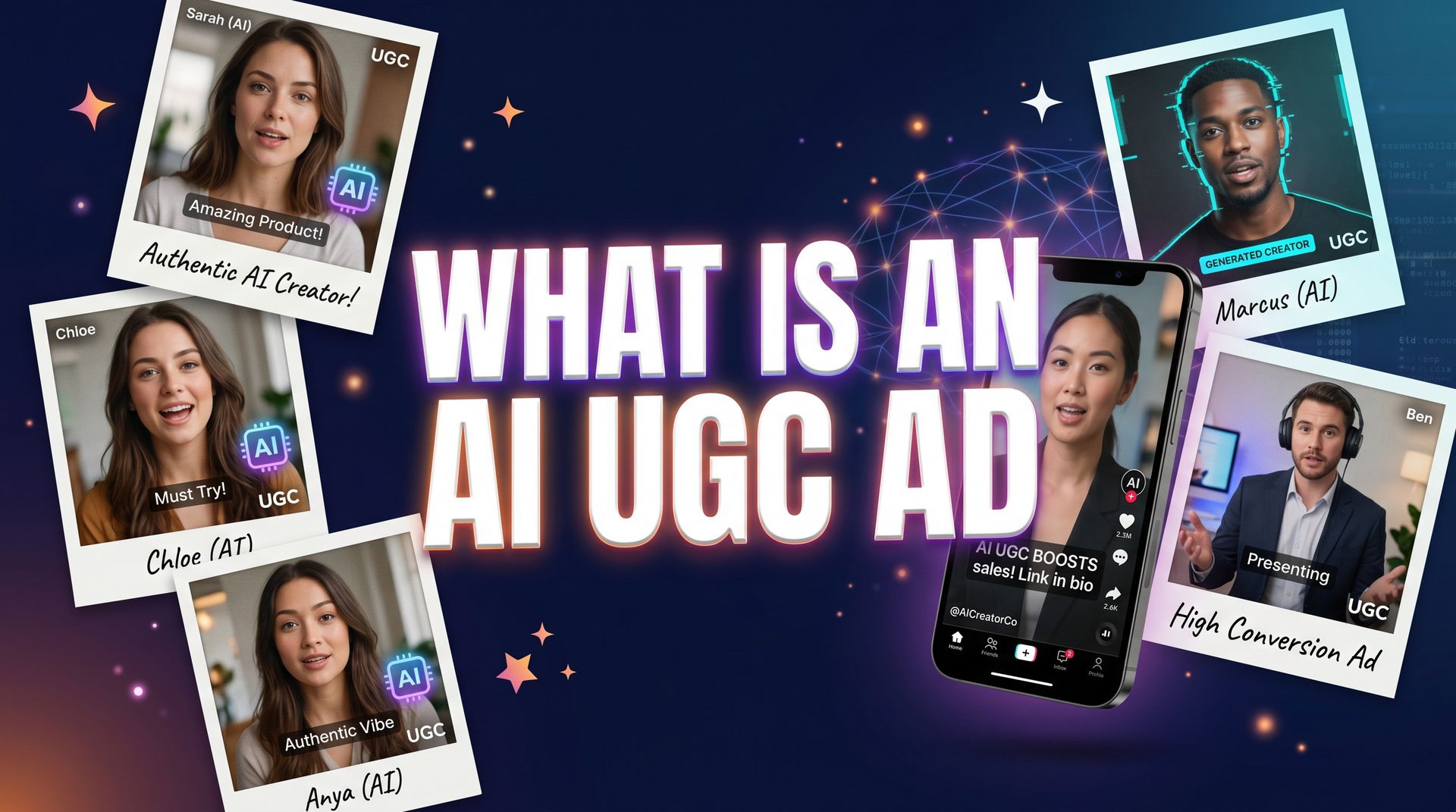
An English-learning app called Learna AI scaled to roughly $800k MRR in nine months - running 300 concurrent ads, almost none of them shot with a real creator. The "talent" was a library of AI actors licensed from Arcads, reading scripts written by Perplexity, voiced by ElevenLabs, assembled in an afternoon. The total creator budget? Under $500. Welcome to the AI UGC era, where the unit economics of video ads broke in half overnight - and where most advertisers are still producing content that gets flagged as fake within the first three seconds.
The Bottom Line: AI UGC ads are synthetic videos designed to look like authentic creator content - generated at roughly $2-11 per video instead of the $150-500 a human creator charges. The problem: most flops aren't caused by weird hands or uncanny faces. The real tell is the script. AI-written UGC uses perfect grammar, no contractions, and zero filler words - a dead giveaway that no human actually recorded it. The brands winning with AI UGC use it as a testing layer (100+ variations at $11 each) then hire real creators to re-shoot winners.
So What Actually Is an AI UGC Ad?
AI UGC (user-generated content) ads are video ads that mimic the look and feel of organic creator content - selfie-framed, casually shot, first-person testimonial style - but the "creator" on camera is either a fully synthetic avatar, a licensed likeness of a real actor, or a digital clone of a hired performer. Voice is cloned or synthesized. The script is usually AI-written. The lip sync is algorithmic.
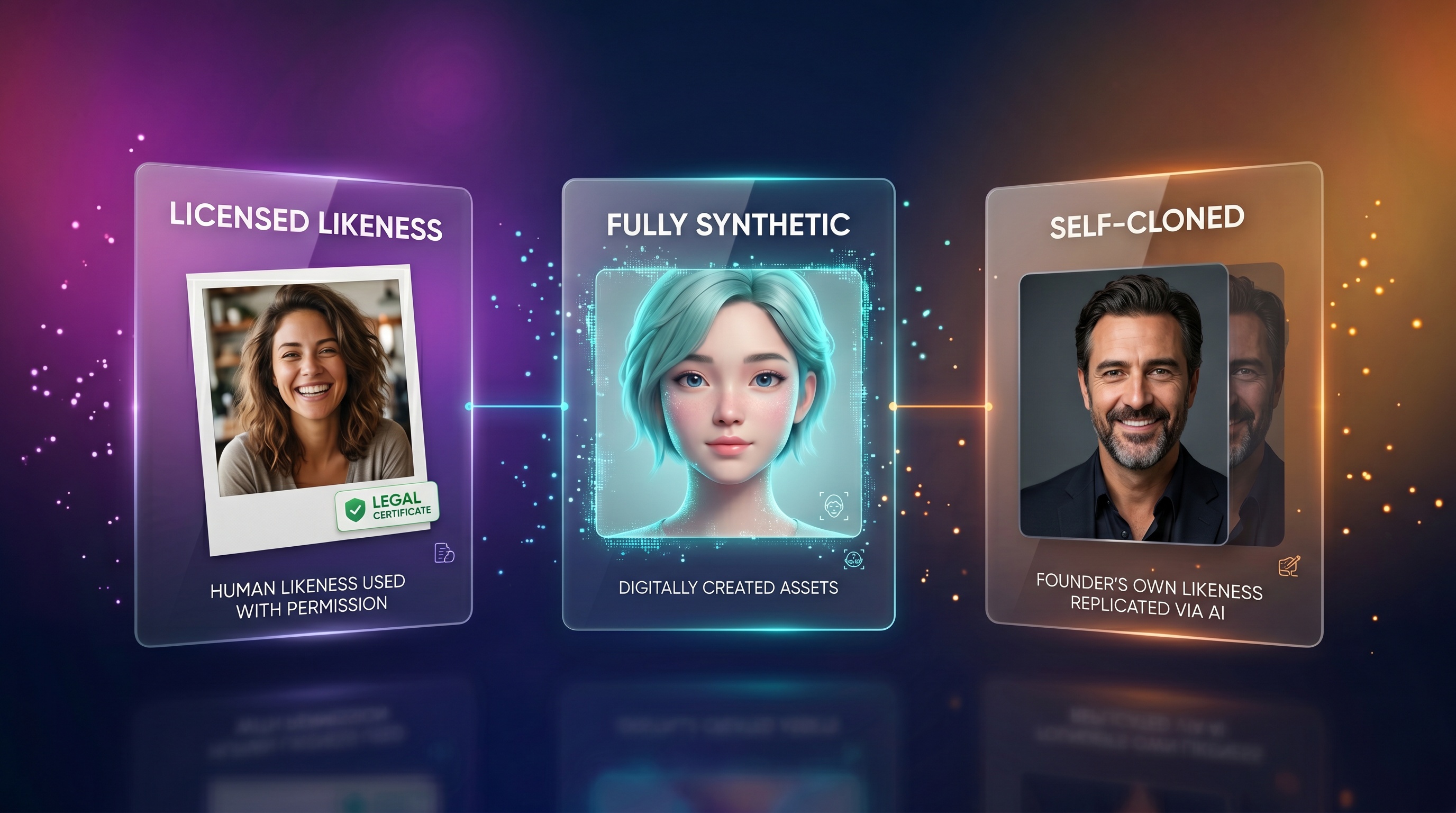
Three architectures dominate the space, and they matter because Meta's new disclosure rules treat them differently:
1. Licensed-Likeness (Arcads)
Real humans legally licensed their face and voice. Arcads has ~1,000+ actors in its library - each one consented. You're technically rendering a real person reading a script they never spoke. Feels the most human, but still requires AI disclosure under Meta's 2026 rules.
2. Fully Synthetic (HeyGen, Creatify)
Avatars generated from scratch or assembled from composite training data. HeyGen has 1,100+ avatars across 175+ languages. Cheaper and faster but more prone to the "rubberized" uncanny look in close-ups.
3. Self-Cloned (Icon.com, Hoox)
A founder or employee records a 2-minute consent video, then the platform clones them. Every subsequent ad uses their face and voice without them ever filming again. Highest authenticity score - if your founder is camera-likeable.
The per-video economics explain why AI UGC went from niche to default in under 18 months. A traditional UGC creator charges $150-500 per video, takes 5-10 days, and will usually give you 2-3 takes before you're paying extra for revisions. Arcads delivers at ~$11 per video with a two-minute turnaround. Creatify and HeyGen sit in the $2-6 range at batch volume. An inBeat agency study found AI UGC can be up to 73% cheaper than traditional UGC on a per-unit basis.
Everyone Is Already Using This (Whether They Admit It or Not)
AI creative in ads isn't a "maybe adopt this year" conversation anymore. It's already baseline infrastructure:
| Metric (2025-2026) | Value | Source |
|---|---|---|
| Marketers using AI for content/ads | 80%+ | HubSpot State of Marketing 2026 |
| Meta AI video generation tool run-rate | $10B annualized | Meta Q4 2025 earnings |
| Undisclosed AI content as % of Meta rejections | 14% (3rd largest category) | Meta March 2026 policy data |
| CTR spread between AI avatars on same script | up to 180% | Startup Spells / Arcads playbook |
| Creatify case-study CPA reduction | 28% lower CPR, 31% lower CPC | Creatify internal benchmark |
| Consumers expecting AI disclosure | 94% | Deloitte Gen AI Trust Standards |
| FTC fine per undisclosed synthetic endorsement | $51,744 | FTC finalized rule (2024, enforced 2025+) |
Notice the tension in the numbers. AI UGC is cheaper, faster, and demonstrably works (28% CPA drops, up to 180% CTR variance between avatars). But rejection penalties are stacking up, consumers demand disclosure, and the FTC is writing $51k checks per undisclosed synthetic testimonial. The tool is a scalpel - wield it badly and it cuts you.
The Real Uncanny Valley Is the Script, Not the Face
Go look at ten AI UGC ads on your feed tonight. You'll spot most of them instantly - but not because the hands are glitchy or the eyes look dead. The visual models got surprisingly good in 2025. The tell is almost always the script.
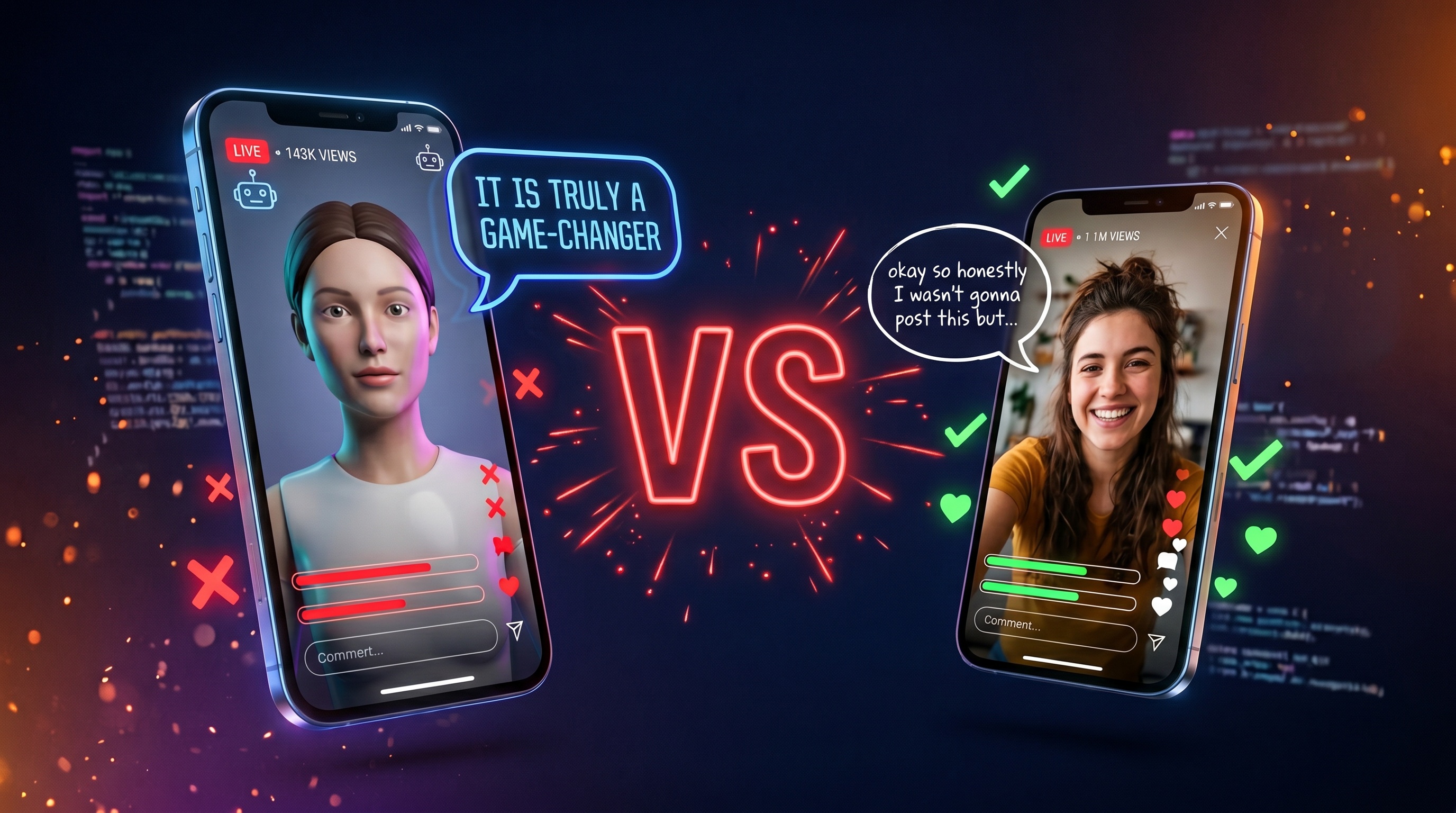
Real people don't speak in complete sentences. They use contractions ("you're", "I'd", "that's"), start thoughts with "And" or "But", trail off mid-sentence, repeat themselves, and pepper everything with filler words like "honestly", "I mean", "basically", and "like". AI-written UGC almost never does any of this. The default output from ChatGPT reads like a press release wearing a hoodie.
Spotted by media buyer Barry Hott (@barryhott), who has managed $600M+ in Meta spend:
"If marketing is too pretty, it's probably not going to work on paid social. If something looks like an ad and feels like an ad, a majority of people are probably not going to look at it."
The AI-UGC corollary: if the script sounds like marketing copy read aloud, the ad dies in the first 3 seconds - no matter how good the avatar looks.
The AI-Script Tells (Why It Flops)
- Perfect grammar with zero contractions ("I have tried" instead of "I've tried")
- Three-beat parallel structure ("It's fast, it's easy, it's affordable")
- Sentences that end with a clean, sell-y CTA
- No "um", no "like", no restarts, no mid-sentence tangents
- Curly smart quotes instead of straight apostrophes in captions
- The phrase "game-changer", "revolutionary", or "must-have" anywhere in the script
What Actually Sounds Human
- "Okay so, I wasn't gonna post this but…"
- "Honestly? I was kinda skeptical at first."
- "And I know that sounds dumb but like - it worked."
- Incomplete sentences. Interrupted thoughts.
- Specific numbers only a real person would know ("I've been using it for like four weeks now")
- The camera re-adjusts. A hair gets tucked. A pet walks by.
Hustler Marketing's creative team put it plainly: "The fact that you know those ads exist means that you know that an AI UGC video generator made them. You can spot it, usually from the first few seconds." The fix isn't a better avatar. It's a better script. Rewrite every line the AI gives you out loud. If it sounds like a LinkedIn post, scrap it.
Meta's March 2026 Rules Just Reshuffled The Deck (And It Might Favor AI UGC)
On paper, Meta's March 2026 policy overhaul looks like bad news for AI UGC. The headline changes:
March 2026 Meta Policy - What Changed
- Partnership Ads now mandatory for any compensated creator content. Running a paid-creator UGC ad without the Partnership Ads designation is classified as a "Deceptive Practice" violation - immediate rejection, significant account health penalty.
- AI disclosure labels required on any ad where AI generated or substantially modified the visual subject (a person, a product render, a scene). Color-correction and headline optimization are still exempt.
- Creator claim liability now flows back to the brand. If a creator says "this cleared my acne in two weeks" and you boost the post as an ad, Meta treats the claim as yours under the misleading-claims policy.
- 34% higher rejection rates in health, beauty, and wellness verticals compared to Q4 2025.
- Proactive AI scanning of every submission for C2PA metadata and synthetic artifacts before first impression is served.
Here's the counter-intuitive part: the Partnership Ads mandate actually favors AI UGC for many small and mid-size advertisers. Why? Because Partnership Ads require a real creator account on the other end, a 90-day consent-reverification cycle, and equal liability for their claims. That's a ton of compliance work for a $5K test budget.
AI UGC that uses licensed likeness (Arcads) or self-cloned founders (Icon.com) doesn't have a "creator partner" in the regulatory sense. You own the IP. You wrote the script. You attach the AI label, stay out of the Partnership Ads bucket entirely, and ship. The catch: you still need the AI disclosure badge, and Meta's classifiers are now good enough that trying to hide it will burn your account.
From a GrowthHQ analysis of the March 2026 policy:
"The distinction between 'AI-assisted' and 'AI-generated' content matters. Using AI for color correction, cropping, or headline optimization does not require disclosure. Using AI to generate the visual subject of the ad - a person, product render, or scene - does."
Build AI UGC That Doesn't Scream "AI UGC"
AdMakeAI's UGC Generator is designed for the testing-layer workflow: scripts written to sound like real people, avatar variations so you can find the 1-in-20 that converts, aspect ratios pre-set for Reels and TikTok, and AI-disclosure metadata baked in. Ship 20 variations of your hook in the time it takes to write one email to a creator.
The AI UGC Tool Landscape, Honestly Compared
Every review site says "it depends on your use case" because they're afraid of losing affiliate commissions. Here's the actual tradeoff matrix based on landing-page pricing, documented case studies, and Reddit/Trustpilot threads:
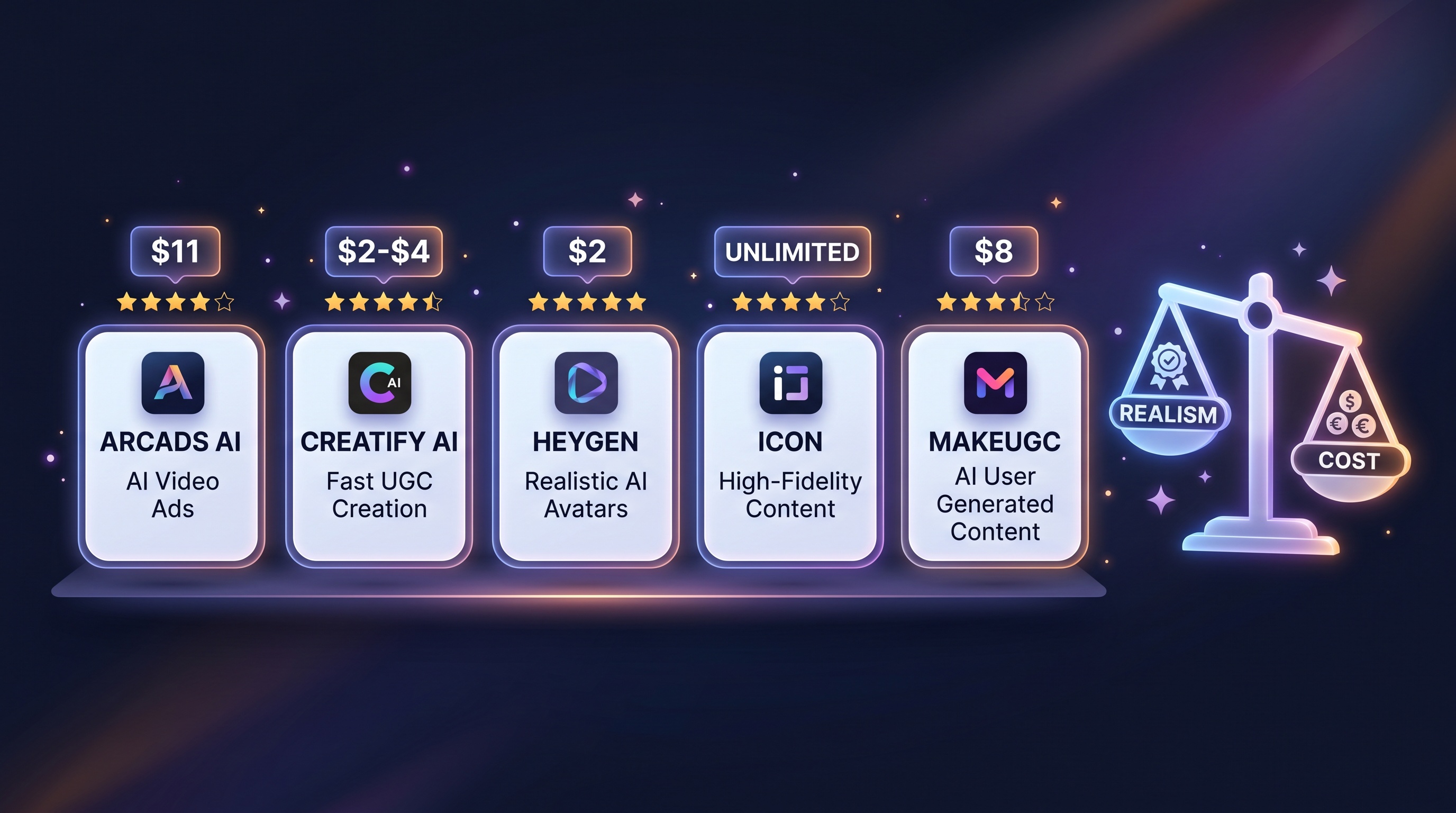
| Tool | Starting Price | Effective Per-Video | Best For | Known Tradeoff |
|---|---|---|---|---|
| Arcads | $99/mo | ~$11/video | Highest realism, licensed actors | Priciest at scale |
| Creatify | $39/mo | ~$2-4/video | High-volume testing, ROAS dashboards | Lip-sync quality below Arcads |
| HeyGen | $29/mo | ~$2/video | 1,100+ avatars, 175+ languages | Studio/corporate feel, "rubberized" faces |
| Icon.com | $39+/mo | Unlimited (plan-based) | Founder cloning, full ad workflow | Heavy setup for clone training |
| MakeUGC | $39/mo | ~$8/video | Startup plan entry, 5 videos/mo base | Smaller avatar library |
| Traditional UGC creator | $150-500/video | $150-500 | True authenticity for scaling | Slow, coordination-heavy, inconsistent |
One Trustpilot reviewer on Arcads: "Very disappointing. £100 just to try, and most marketed features don't work as well as suggested." That's the honest downside. These tools are not magic. They shorten the production loop from weeks to hours, but they still demand a human in the loop for script rewrites and taste.
The Hybrid Workflow 8-Figure DTC Brands Actually Use
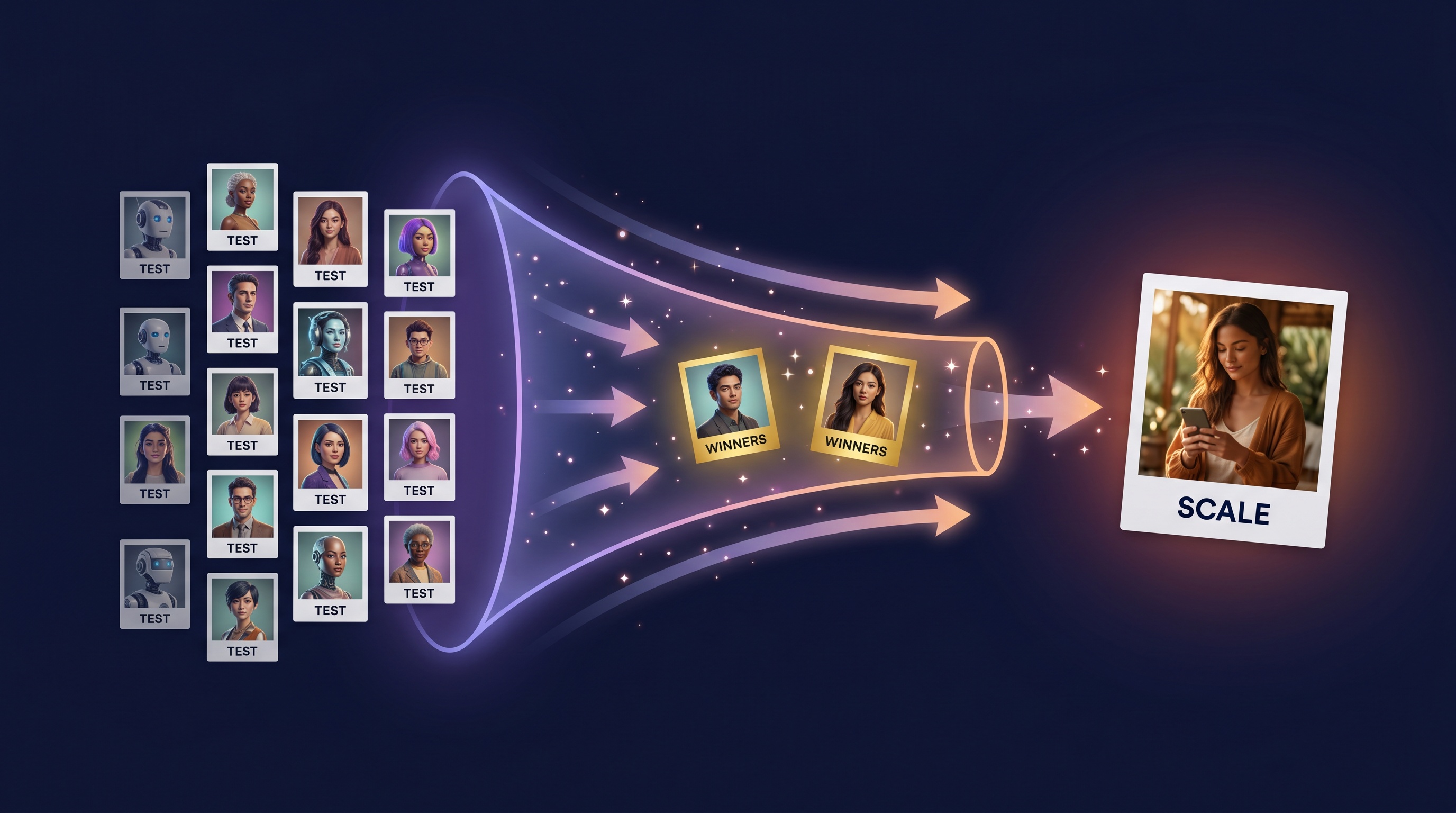
Here's the quiet consensus among operators spending six figures a month on Meta: AI UGC is the testing layer. Human UGC is the scaling layer. Nobody serious is betting a $50K/day budget on a pure-AI campaign. They're also not running 200 creative tests with human creators at $300 each.
The pattern, distilled from the Startup Spells Arcads playbook, Barry Hott's Ugly Ads curriculum, and Creatify's case-study library:
The 5-Step AI-to-Human Pipeline
- Hook mining (AI). Use Perplexity or an LLM to extract 20-50 distinct angles from competitor ad libraries and customer reviews. Each angle becomes a script seed.
- Script drafting (AI + human rewrite). Generate initial scripts, then read them out loud. Rewrite until they pass the "would my roommate actually say this?" test. Contractions in. Corporate words out.
- Actor multi-variate (AI). Run the same script through 10-20 different AI avatars on Arcads or Creatify. Target budget: ~$10K over six weeks across 100 variants. Expect up to a 180% CTR spread between best and worst avatars on identical copy.
- Winner identification (platform ML). Let Meta's algorithm allocate spend across 5-10 creatives per ad set. One or two will separate from the pack inside 72 hours.
- Human re-shoot of winners (scale layer). Take the winning hook + script + actor archetype and hire a real creator at $300-500 to re-shoot the same concept with authentic pauses, environment, and live delivery. Human versions typically lift CTR another 15-30% and fatigue slower than their AI counterparts.
This is why pure AI-UGC-only operators plateau. The AI layer is a probability-weighted search for "which angle works". The human layer is where you cash in the winning angle at scale. Skip the human layer and your ads fatigue in 10-14 days flat because every scroll reveals another version of the same synthetic person saying the same synthetic thing.
When AI UGC Genuinely Flops (And When You Should Skip It)
AI UGC is not a universal hammer. The categories where it still underperforms human creators badly:
Skip AI UGC For:
- Regulated health claims. 34% higher rejection in health/beauty post-March 2026. A synthetic face claiming medical results is Meta's worst nightmare.
- Trust-sensitive verticals. Finance, insurance, legal. The "trust-whiplash" moment when a viewer realizes the testimonial is synthetic is fatal.
- Before/after transformations. Weight loss, skincare, fitness. The viewer assumes the "after" is fake the moment they clock the AI.
- Hyper-niche subcultures. Climbing, fly-fishing, tabletop RPGs. Insiders can smell an outsider script from 10 feet away.
Lean In Heavily For:
- Early-funnel hook testing. Find which angle grabs attention before spending human-creator budget.
- Localization at scale. 175+ languages in HeyGen is genuinely unmatched - paying 40 creators in 40 countries is not realistic.
- App installs and SaaS. Tolerance for synthetic creators is higher when the product itself is software.
- Dropshipping / low-AOV SKUs. Under $40 AOV, viewers care less about the creator and more about the demo.
- B2B software. Business audiences are used to explainer-style content and tolerate AI avatars well.
A concern voiced in a r/PPC thread that keeps getting brought up:
"When anyone can generate a fake person recommending any product, UGC ads become 10x more skeptical. We're going to kill the golden goose."
The counter-argument from operators: the golden goose is already mostly cooked. Trust in influencers has been eroding for five years. The brands that win will be the ones transparent about AI while still producing content that feels honest.
If You're Starting From Zero This Week
A concrete week-one plan that reflects how actual operators onboard AI UGC without burning budget on bad variants:
Week 1: Discovery
- Scrape 30 recent competitor ads from the Meta Ad Library. Transcribe them (Whisper does this in minutes). Pull out every unique hook - expect 8-15 distinct angles.
- Generate 3 script variations per angle, rewrite each one out loud until it stops sounding like a press release. Use the AI Ad Agent to stress-test the angles against your product.
- Pick one tool based on the comparison table above. Start with a single month of Creatify or Arcads - don't buy annual until you know what works.
- Generate 5 variants per script (5 scripts × 5 avatars = 25 ads). Budget $10-15/day per ad for 3 days.
- Attach the required Meta AI-disclosure label. Do not try to hide synthetic origin - 14% of all Meta rejections are now undisclosed AI.
- After 72 hours, kill the bottom 60%. Double-spend the top 15%. The winning avatars are rarely the ones you would have picked intuitively.
- The following week, hire one real creator at $300-500 to re-shoot the winning script in their own environment with real pauses. Run that against the AI winner.
The brands winning in 2026 aren't the ones who went all-in on AI or all-in on humans. They're the ones who figured out that AI UGC is a search algorithm for creative ideas - and that you still need a human to deliver the winning idea when it's time to scale.
Run the Test Layer Inside AdMakeAI
Generate UGC-style ads, batch-variant hooks across dozens of avatars, and scrape winning competitor creatives - all in one workflow. Pair with our Ad Set Studio to pre-wire 20+ variations of the same concept before you even upload a brief.
Free credits included · Generate 20 UGC-style variants in minutes
Related Resources
Why Ugly Ads Outperform Your Polished Studio Shots
The authenticity data behind why raw beats polished - the foundation for everything AI UGC is trying to replicate.
Why Winning Ads Die After 2 Weeks
AI UGC fatigues faster than human UGC. Here's how operators extend ad lifespan with variant rotation.
AdMakeAI UGC Generator
Ship UGC-style ads with scripts that don't sound like ChatGPT wrote them - in minutes, not days.
Competitor Intelligence
Mine 30+ competitor hooks in an afternoon - the first step of the hybrid workflow.
How to Create Facebook Ads with AI (2026 Guide)
The full AI-assisted ad workflow from script to publish.
Ad Set Studio
Batch-generate 20+ variants of a single concept - the creative testing volume that AI UGC makes economical.
Ready to create winning ads?
Research what competitors are running, then generate your own on-brand ads in minutes.