Your Next Winning Ad Is Already Written (By Your Customers): The Amazon Review Mining Method
The exact methodology 8-figure media buyers like Nick Shackelford use to mine Amazon reviews for ad hooks that convert. One-star reviews reveal competitor weaknesses. Five-star reviews reveal customer language. Here's the step-by-step playbook.
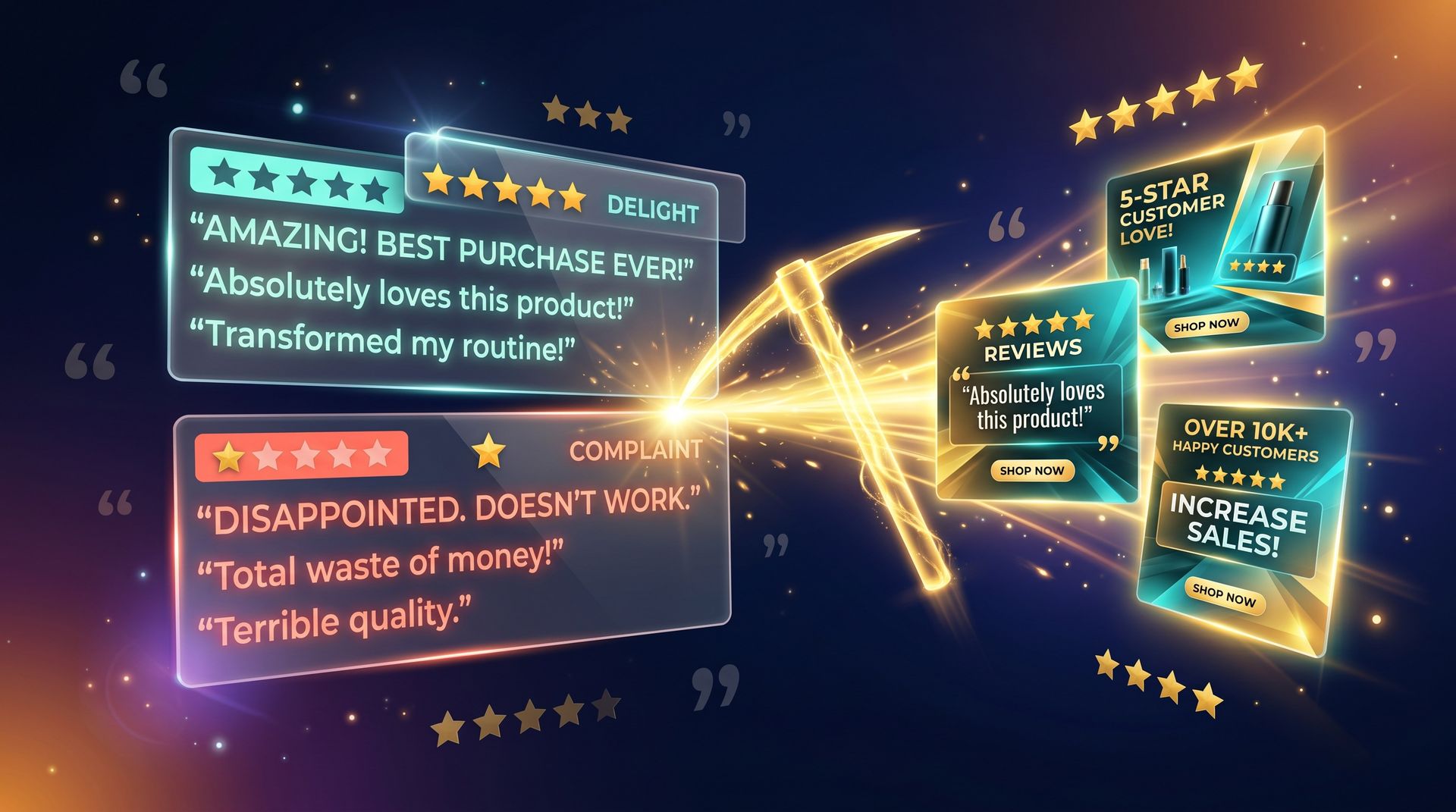
Your best ad copywriter isn't on your team. She wrote a one-star review of your competitor at 11:47 PM last Tuesday, furious that the "breathable" yoga pants gave her a rash, the customer service ghosted her email, and the color in the photo "looked nothing like what showed up." She just handed you three hooks, an angle, and a positioning wedge. You're just not reading her work.
The Bottom Line: 8-figure media buyers like Nick Shackelford (Structured Agency), Barry Hott (ex-growth at Smile Direct, Liquid Death), and Ben Heath don't brainstorm ad copy in a Google Doc. They mine it from Amazon reviews, App Store comments, Trustpilot complaints, and Reddit rants. One-star reviews reveal what competitors are doing wrong. Five-star reviews hand you the exact phrases customers use when they're obsessed. This is the playbook.
Why Raw Customer Language Beats Everything You Could Write
There is a reason the best-performing DTC ads often sound like a text message from your slightly-too-honest friend. It is because they literally are. Top media buyers don't write copy - they transcribe customers.
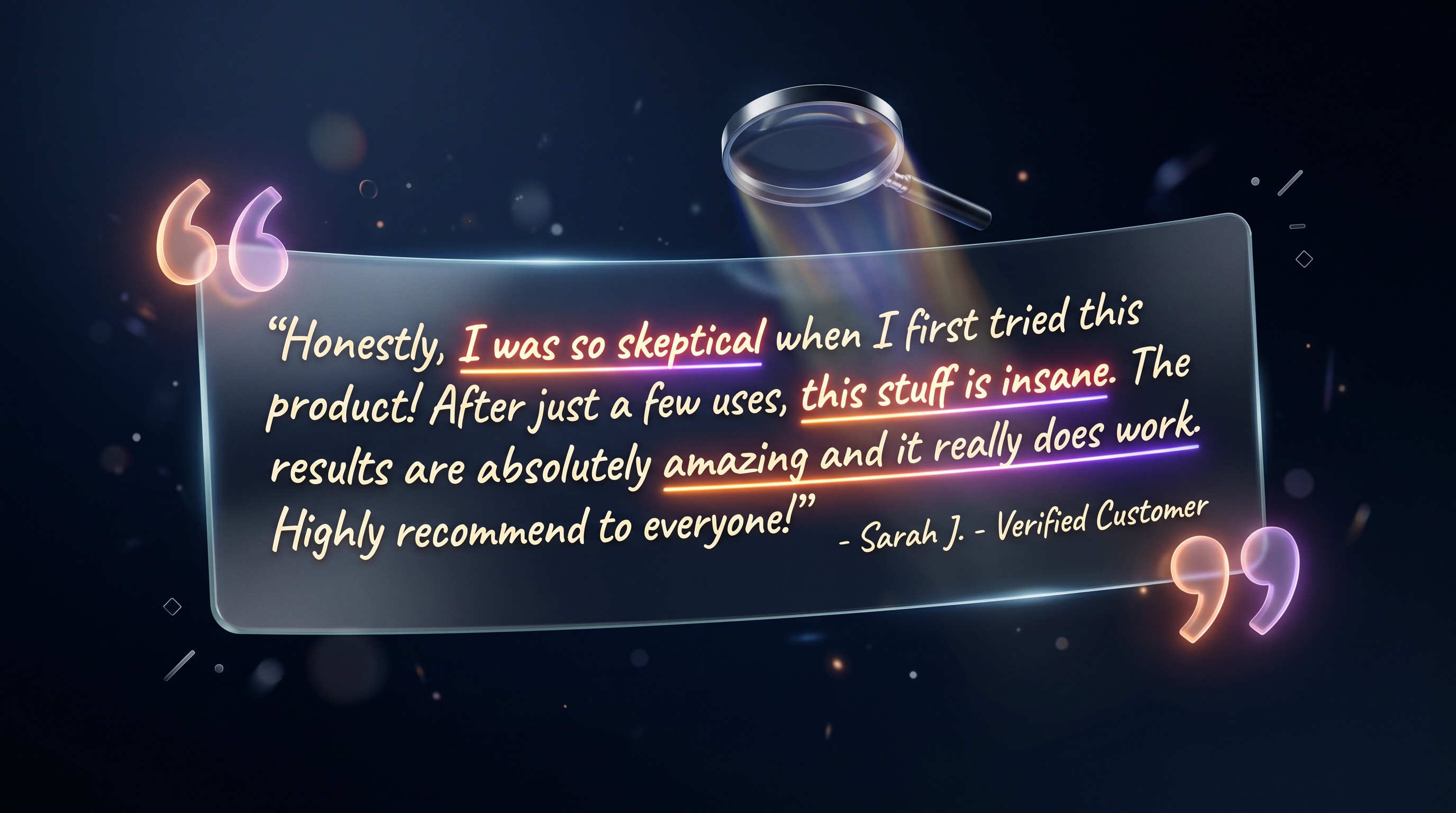
The reason is simple: raw customer language passes an invisible authenticity filter that the human brain does in about 400 milliseconds. "Highly effective hair serum" sounds like an ad. "This stuff is insane, my hair actually grew back on my temples" sounds like a real person. One gets scrolled past. One gets saved and screenshot.
| Marketing-Speak (Skip) | Raw Review Language (Stop Scroll) |
|---|---|
| "Premium, long-lasting fragrance" | "My husband keeps asking what I'm wearing. This never happens." |
| "Restores youthful skin" | "I thought it was a scam. Three weeks later my mom asked if I got Botox." |
| "Clinically proven results" | "I was so skeptical I bought the smallest size. I'm on my fourth bottle now." |
| "Advanced sleep technology" | "I haven't slept through the night in 6 years. I slept 9 hours on night two." |
| "Industry-leading durability" | "I've had mine 4 years. My dog chewed it. I ran it over with my car. Still works." |
Nick Shackelford (Structured Agency, $100M+ managed spend):
"Your customers are out there writing better copy than you can, every single day. You just have to go collect it. We grab the top 100 reviews on the biggest competitor product on Amazon, paste them into Monkey Learn, and let it surface the most common phrases. Those phrases become hooks."
This is not a creative trick. In marketing circles this is called Voice of Customer (VoC) research - and it is the single highest-leverage activity a media buyer can do before opening Ads Manager. Brands that build their entire ad library from VoC data - Liquid Death, Lemme, Hiya Health, Magic Spoon - consistently beat brands that don't, because they are not guessing what customers care about. They are quoting them back to themselves.
The Shackelford Amazon Review Mining Workflow (Step by Step)
Nick Shackelford has talked about this system across podcasts, tweets, and inside his Structured courses. Here is the exact workflow, condensed and adapted for 2026 tools:
Step 1 - Find the Category Giant, Not Yourself
Don't mine your own reviews. You already know your customers. You want reviews on the #1 bestselling competitor in your category - the one stealing attention you want. Go to Amazon, type your category ("collagen powder," "blue light glasses," "dog training treats"), filter by best sellers.
Pull the top 2-3 bestsellers. Open each product page.
Step 2 - Extract 100+ Reviews
Three options:
- Helium 10 Review Insights (inside the Diamond plan, ~$229/mo) - exports all reviews to CSV with star rating, verified-purchase flag, and date
- Jungle Scout Review Analyzer - similar but with a built-in sentiment engine
- Free method - copy-paste the top 100 reviews directly into a text file. Slower, but works. Sort by "Most Recent" and "Top Reviews" to get a balanced sample.
Aim for 100 minimum. 300+ is better. The more data, the clearer the patterns.
Step 3 - Split 1-Star from 5-Star
This is the critical sort. One-star reviews and five-star reviews serve different purposes:
- 1-star reviews = competitor weak points you can attack in your angle ("unlike Brand X which shed hair everywhere, ours…")
- 5-star reviews = the exact language your best customers use when they're obsessed ("my husband keeps asking what I'm wearing")
- 3-star reviews = the most honest ones, where people list what they liked AND didn't - often the richest hook mine of all
Step 4 - Theme the Language
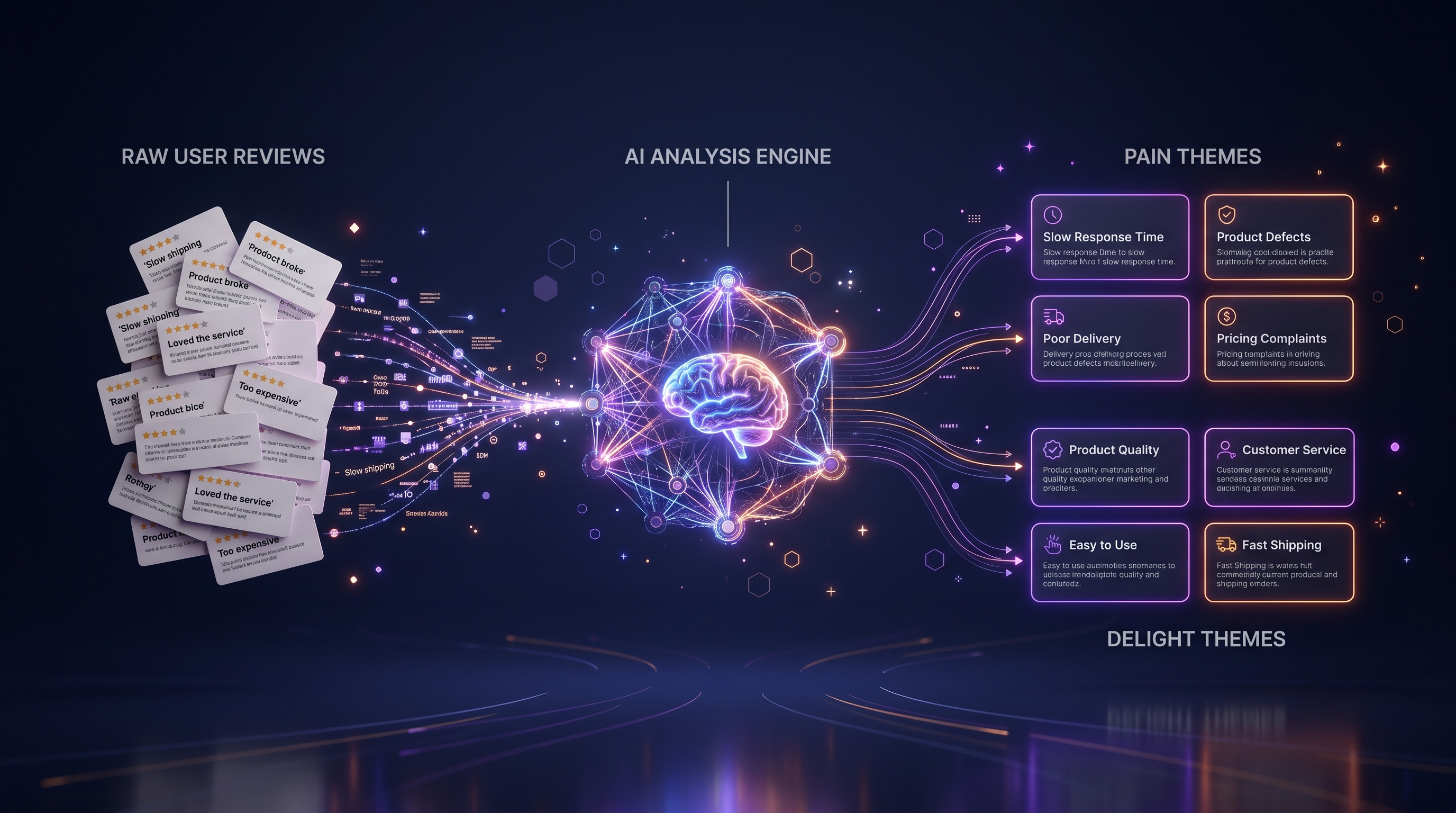
Shackelford's original method used Monkey Learn - a no-code NLP platform that extracts keywords, phrases, and sentiment from blocks of text. In 2026 you can do the same thing in ChatGPT or Claude with a single prompt (we'll give you that prompt below).
You're looking for three buckets:
- Pain themes - what was broken before they bought ("I had tried every mascara…")
- Delight themes - the moment of realization it worked ("I couldn't believe…")
- Unexpected benefits - benefits customers talk about that the brand never advertised ("didn't expect it to help my sleep too")
Step 5 - Turn Themes Into Hooks (Not Angles)
This is where most people mess it up. They confuse hooks with angles. Ben Heath, who runs one of the largest Meta ads agencies in the UK, puts the distinction cleanly:
"The angle is the core focus of the ad - the reason your prospect should buy. The hook is the first 3 seconds that earns the right to deliver the angle."
- Ben Heath, Lead Guru
Example. From a 5-star collagen review: "I'm 47 and my nails finally stopped peeling for the first time since high school."
- Angle: Targets women 45+ frustrated by decades of peeling nails
- Hook: "47 years old. My nails haven't been this strong since high school." (straight quote, word-for-word)
Why One-Star Reviews Are the Real Goldmine
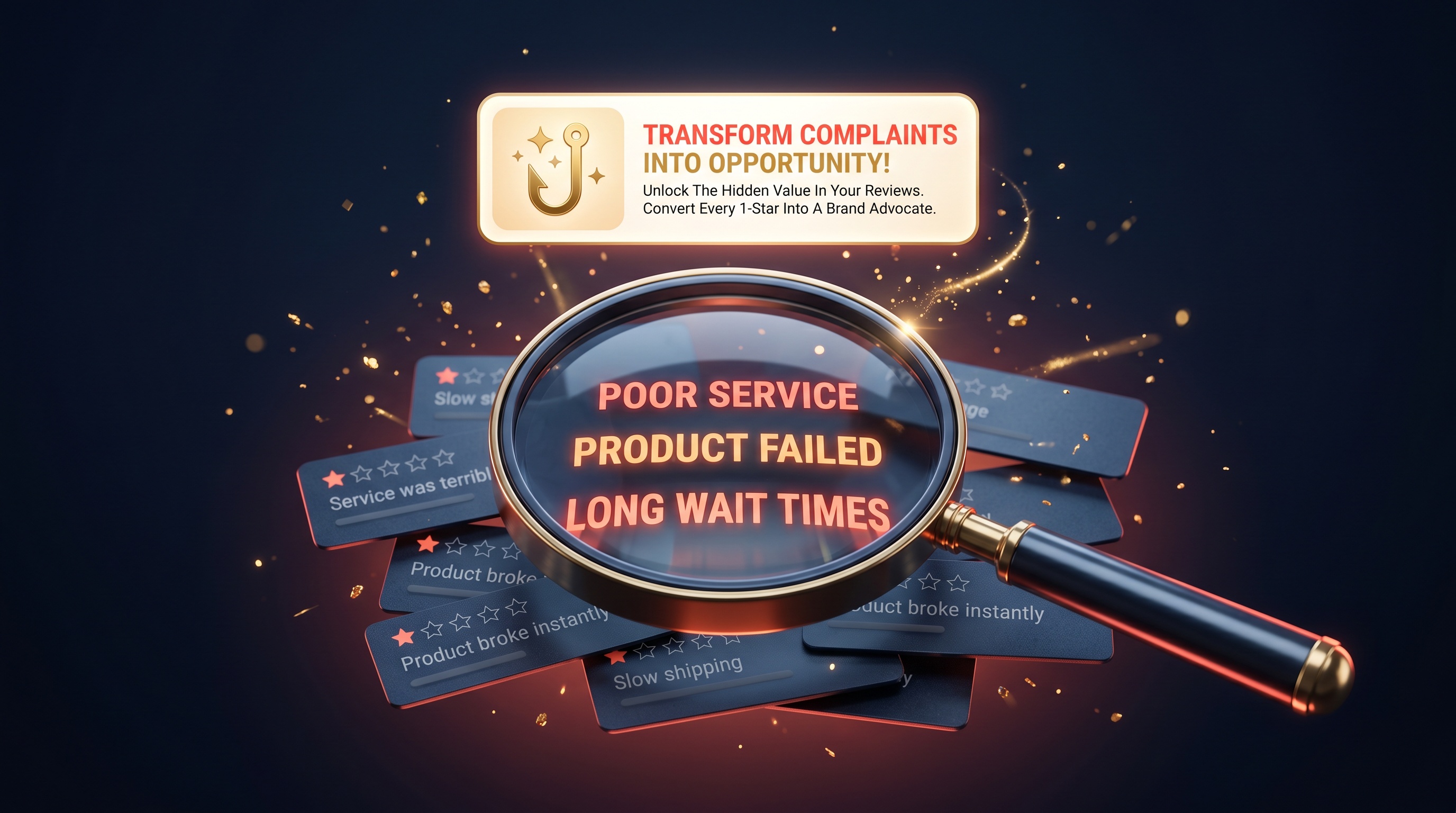
Barry Hott - growth marketer who worked on Liquid Death, Smile Direct Club, and Obvi - is known for being pathological about one-star reviews. His logic:
Barry Hott on Twitter/X:
"Pain language is the most underused asset in advertising. Everyone quotes happy customers. Nobody quotes angry ones. But the angry customer of your competitor is literally writing your ad for you - they're saying exactly what your product fixes, in the exact words that other frustrated buyers will recognize instantly."
A one-star review is a market research interview that cost you zero dollars. The reviewer spent 20 minutes angrily typing everything wrong with a product in your category - every friction point, every broken promise, every unmet expectation. If your product solves even one of those, you have a pre-built hook.
Real Example: Skincare Brand (Sunscreen Category)
A DTC sunscreen brand mined 1-star reviews on the top 3 bestselling mineral sunscreens on Amazon. Three themes appeared 40+ times across reviews:
- "Leaves a white cast, especially on darker skin"
- "Smells like chemicals / feels greasy"
- "I bought this thinking it was reef-safe but the ingredients list says otherwise"
They ran three ads, each a straight quote-style static:
- "Tired of sunscreen that turns your skin grey?"
- "I hated sunscreen. Then I tried one that didn't smell like a pool."
- "I thought my old sunscreen was reef-safe. Then I read the ingredients."
The first ad drove a 3.2x CTR lift over their previous best hook and dropped CPA by 41%. It wasn't a clever line - it was a direct paraphrase of what 40 frustrated customers had written.
What to Look For in 1-Star Reviews
- "I bought this thinking X but actually it did Y" - mismatch between promise and reality
- "It worked but…" - the "but" is a positioning wedge
- "Customer service was…" - service gaps you can exploit
- Specific sensory complaints - smell, texture, weight, fit
- Wasted-money language - "I want my $40 back" = pain around price+outcome gap
Five Review Sources Beyond Amazon (That Most Buyers Ignore)
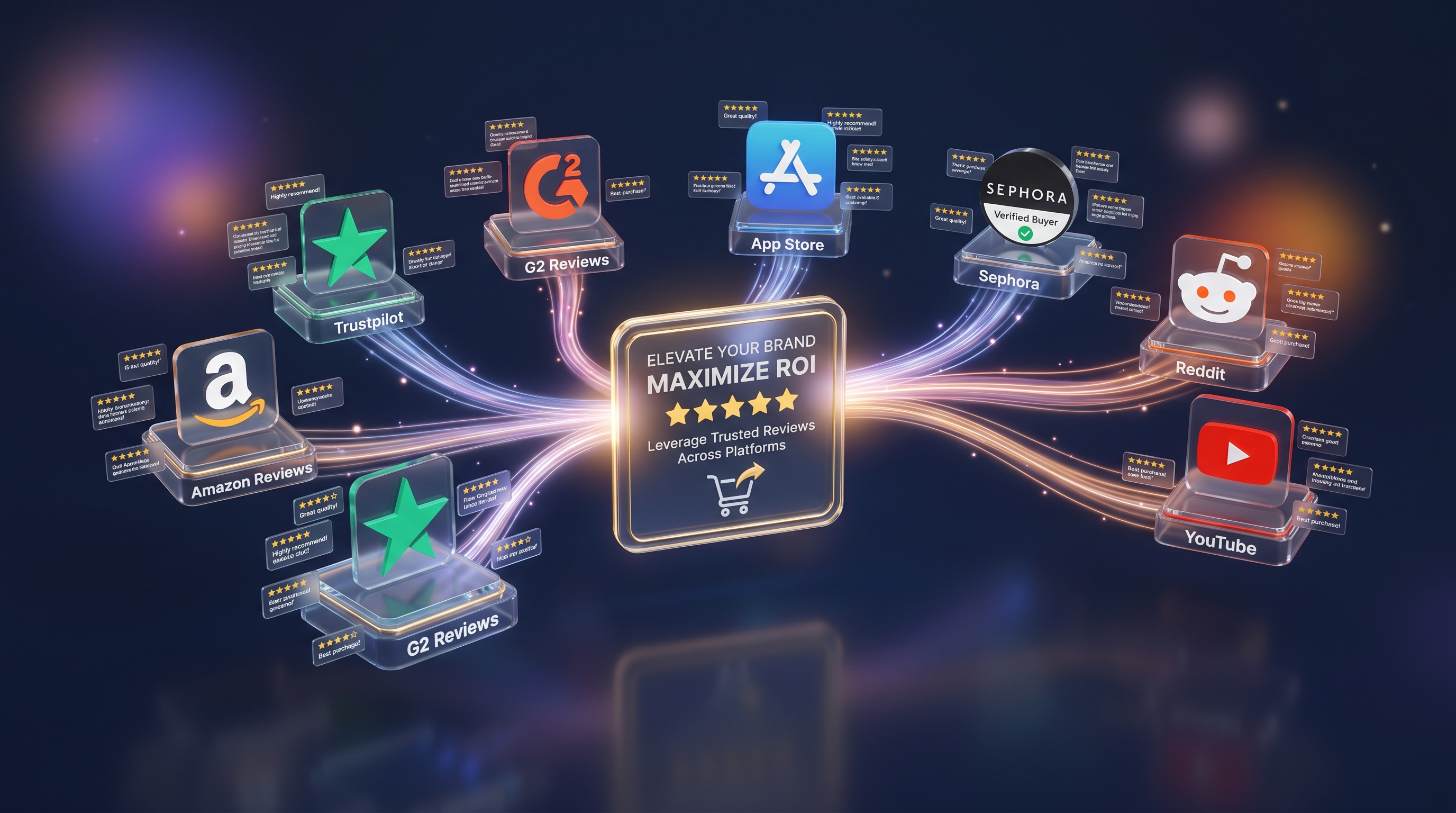
Amazon is the default. But it's not always the best source for your product. Here's where else to mine - and why each source reveals different language:
1. Trustpilot
Best for: DTC subscription brands, services, fintech, travel. Reviewers skew older and more verbose. People here write essays - rich with context and specific frustrations.
Look for: service-failure stories with timelines ("I ordered March 14… still nothing April 2")
2. G2 and Capterra
Best for: SaaS, B2B tools. Reviewers list their "least favorite feature" and "what problem are you solving" in structured form - a hook template you can literally copy.
Look for: the "Cons" section on competitor listings
3. App Store and Google Play
Best for: any app, but also any physical product with a companion app (Oura, Whoop, Peloton, 8Sleep). 1-star mobile reviews are unhinged in the best way - raw, angry, specific.
Tool: AppFollow or Sensor Tower to export
4. Sephora and Ulta
Best for: beauty, skincare, haircare, fragrance. Sephora reviews are the most descriptive on the internet - reviewers include skin type, age, concerns, and detailed before/after. Pure gold for hook templates.
Look for: filter by "Skin Concern" or "Skin Type" to find audience-specific language
5. YouTube Comments
Best for: anything with unboxing or review videos. Comments under competitor review videos are where skeptics AND converts congregate. Sort by "Top comments" to find social-proof language.
Pro: search "honest review [competitor product]" - comments under "honest" reviews are the most candid
6. Reddit Threads
Best for: everything. Search "site:reddit.com [category] best" or "[competitor brand] worth it." Reddit threads are the raw unfiltered voice of the category - zero marketing filter.
Key subs: r/SkincareAddiction, r/BuyItForLife, r/Supplements, r/Fitness, r/Frugal
Hook Template Patterns You Can Steal From Real Reviews
After mining thousands of reviews across categories, certain sentence patterns repeat constantly. These are not templates you invent - they are patterns real customers use. When you see one in a review, you have a hook skeleton.
| Pattern | Real Review Source | Usable Hook |
|---|---|---|
| "I bought this thinking X but…" | Cheap headphones Amazon 1-star | "Bought these thinking they'd be good enough. They weren't." |
| "I was skeptical about…" | Sephora hair growth serum 5-star | "I was skeptical. I'm on bottle three now." |
| "I've tried every X in the world…" | Trustpilot weighted blanket | "I've tried every sleep hack on TikTok. This is the first one that worked." |
| "I didn't expect it to also…" | Reddit magnesium thread | "Bought it for leg cramps. Didn't expect it to fix my 3 AM anxiety." |
| "My [person] keeps asking…" | Ulta perfume 5-star | "My husband keeps asking what I'm wearing. That never happens." |
| "X years of Y and finally…" | Amazon collagen 5-star | "47 years of peeling nails. Finally strong in 8 weeks." |
| "I almost returned it but…" | Amazon mattress topper 5-star | "Day 3 I almost returned it. Day 14 I ordered one for my mom." |
| "Why didn't I buy this sooner?" | G2 SaaS tool 5-star | "Three years of using [old tool]. Switched. Should've done it in year one." |
The Authenticity Test:
Before you run a hook, read it out loud. If it sounds like something a human would text a friend, it's ready. If it sounds like a tagline - rewrite it. Most AI-generated hooks fail this test, which is why review-sourced copy consistently outperforms pure-AI-generated copy.
You've Got the Hook. Now Generate the Ad.
You just mined a killer hook out of 100 competitor reviews. The next bottleneck is design. AdMakeAI takes your hook, angle, and product, and generates scroll-stopping ad creatives in under 60 seconds - no designer, no Photoshop, no 3-day turnaround.
How AI Supercharges the Review-Mining Workflow
Shackelford's original workflow used Monkey Learn. In 2026, a pasted block of 100 reviews into ChatGPT or Claude is faster, cheaper, and often more accurate. Here are the exact prompts top buyers use. Copy them verbatim.
Prompt 1 - Pain Language Extractor (for 1-star reviews)
Prompt 2 - Delight Language Extractor (for 5-star reviews)
Prompt 3 - Angle Builder (the meta-prompt)
Important:
Do not let the AI rewrite the raw phrases. Tell it explicitly: "keep the customer's voice intact." AI models default to sanitizing language - they turn "this stuff is insane" into "this product is remarkably effective." That defeats the entire purpose. The whole edge is that the language is raw.
From Hook to Live Ad in Under 10 Minutes
Once you have hooks, the slowest part of the old process was design. One hook used to mean a brief, a designer, 2-3 days, and $75-200 per creative. Here is the 2026 version:
The 10-Minute Workflow
- Minutes 0-2 - Pick your top 5 hooks from the AI output. Copy them into a doc.
- Minutes 2-4 - Open Ad Set Studio. Paste your product and set general instructions: ad format, aspect ratio, brand style.
- Minutes 4-6 - For each hook, add a separate ad with the specific instructions being just the hook copy. AdMakeAI generates each variation in parallel.
- Minutes 6-9 - Review 5 generated creatives. Pick the 3 strongest. Optionally run them through Create Facebook Ad to generate layout variations.
- Minute 10 - Export. Upload to Ads Manager. Launch.
Bonus: Write Review-Sourced Copy First, Then Match the Visual
Use the free Ad Copy Generator to transform your raw review quote into variations of primary text, headlines, and descriptions. Then feed the winning direction into UGC Generator for authentic-feeling creator-style ads that match the conversational tone.
Five Mistakes That Kill Review-Sourced Ads
1. Sanitizing the Language
"This stuff is insane" becomes "This product is very effective." You just deleted the entire edge. Keep the grammar mistakes. Keep the caps. Keep the slang.
2. Only Mining 5-Star Reviews
You will learn how customers love - not what they hate. Skipping 1-star reviews means skipping the competitive positioning wedge.
3. Mining Your Own Reviews Only
You already know your customers. Mine the category bestseller. That's where untapped language and competitor weaknesses live.
4. Sample Size Under 50 Reviews
You need patterns, not anecdotes. One review saying "weird smell" is noise. Forty reviews saying "weird smell" is a hook. Pull at least 100, ideally 300+.
5. Making Hooks Without Checking Legal
If you quote a review verbatim in an ad creative, make sure it's YOUR product's review with attribution, not a competitor's. Paraphrasing competitor-review-themes is fine; literal quotes of other brands' reviews get you sued. The testimonial ads guide covers which layouts those quotes go into and the FTC rules for quoting reviews.
6. Skipping the 3-Star Reviews
3-star reviews are the most honest - they tell you what worked AND what didn't, from the same person. That's gold-tier market research. Most buyers skip them.
What the Best Media Buyers Actually Say About This
"Grab the top 100 Amazon reviews of the biggest product in your category. Paste them into a spreadsheet. Sort by stars. Highlight every phrase that sounds like a real person talking. That document is your ad library for the next 6 months."
- Nick Shackelford, Structured Agency
"The angry customer of your competitor just wrote your winning ad. They're telling you exactly what's broken, in the exact words the next frustrated buyer will recognize. Stop writing copy. Start transcribing."
- Barry Hott, Growth Marketer
"Your angle is the reason someone should buy. Your hook is the reason they'll stop scrolling long enough to hear the angle. Both should come from the same place: the words customers actually use."
- Ben Heath, Lead Guru
Your 60-Minute Action Plan
This Hour:
- Minutes 0-10 - Find the top 2 bestselling competitors in your Amazon category. Open their product pages.
- Minutes 10-25 - Copy 50 one-star and 50 five-star reviews into a text file for each product.
- Minutes 25-40 - Paste them into ChatGPT or Claude with the three prompts from this post. Get back themed language.
- Minutes 40-50 - Pick 5 hooks. Match each to an angle. Check Competitor Intelligence to see if any competitor is already running similar copy (good signal).
- Minutes 50-60 - Generate 5 ads in Ad Set Studio using your hooks as specific instructions. Launch them as your next test batch.
The brands scaling profitably on Meta in 2026 are not the ones with the most talented copywriters. They are the ones with the best systems for extracting language from customers who already wrote the copy for them. Your customers and their competitors' customers are typing your next winner right now. Your job is to go read it.
Turn Customer Reviews Into Winning Ads
Mine the hooks. Feed them to AdMakeAI. Launch 5 ad variations in under 10 minutes. No designer, no shoot day, no production bottleneck.
Free credits included • Go from review mining to live ad in under 10 minutes
Related Resources
Competitor Intelligence Tool
See which hooks competitors are actually running, then pair them with review-mined language
Ad Set Studio
Batch-generate 5+ ad variations, one per review-sourced hook, in a single session
Free Ad Copy Generator
Turn raw review quotes into primary text, headlines, and descriptions for Meta
UGC Generator
Match review-sourced copy to authentic UGC-style creative - no creator required
Why Ugly Ads Outperform Polished
The companion post: raw customer language + raw-looking creative = highest CTR
Creative Fatigue Survival Guide
Use review-sourced hook variations to refresh winning ads before CPA doubles
Make your next ad from what already runs
Research what competitors are running, then generate your own on-brand ads in minutes.